
What sets a professional coach apart from the rest?
What sets a professional coach apart from the rest?
International Coaching Federation (ICF), the international professional organization for coaches, sets the gold standard for coaches worldwide. In this article, we take a closer look at the required training, practical experience, and competencies needed to become an ACC or PCC coach.
Dorothée Willems

Coaching is not a legally recognized profession.
That likely explains the rapid growth—and confusion—within the coaching landscape. But how does a coach actually work, and what distinguishes a professional coach from the rest?
Coaching The Shift differentiates itself by upholding high quality standards. One of the ways we demonstrate this commitment is through our membership with International Coaching Federation (ICF). Even more so: our coaching program also meets the demanding standards set by the ICF.
This means that Coaching The Shift holds an ICF mandate to administer exams, offering participants the opportunity to apply for an individual ICF credential through an ACTP program.
ICF is the gold standard against which every professional coach measures themselves. Coaching is more than just a title—it is a craft.
Are you looking to become a coach? Or do you want to separate the wheat from the chaff in your search for a professional coach? Start here:
- What is ICF?
- How do I become a professional coach?
- 4 must-have coaching competencies
- The 3 ICF coaching levels
- Stand out and become a professional coach!
- As you sow, so shall you reap
What is ICF?
ICF, or the International Coaching Federation, is the leading professional organization for coaches and for the development of the coaching profession worldwide.
The federation has a clear mission:
“To professionalize coaching by setting high standards, providing independent certification, and building a global network of trained and accredited coaching professionals.”
This mission is carried out through three core pillars, supported by initiatives around the world.
First, training and certifying professional coaches. ICF aims to clearly define the coaching profession and be recognized as a quality label, maintaining the trust of clients and members through professional and objective criteria.
Second, advancing the coaching profession by building a global professional network of coaches. By fostering a strong community, coaches can share experiences, continue to develop, and allow the profession to evolve.
Third, further developing the coaching profession and supporting member growth. ICF represents and defends the coaching profession worldwide—toward organizations, public institutions, and beyond—and actively supports initiatives and research projects that contribute to the values, principles, and techniques of coaching.
How do I become a professional coach?
To obtain an ICF credential, coaches must submit a portfolio to ICF Global demonstrating their education level and coaching experience. To prove their knowledge, they complete the CKA (Coach Knowledge Assessment), an exam based on the ICF core coaching competencies.
Because the coaching profession is continuously evolving, ICF requires coaches to renew their certification every three years. This ensures ongoing quality and professional development.
Throughout the certification process, coaches must also submit audio recordings and written reports of coaching conversations, allowing ICF to assess real-life coaching performance.
ICF recognizes three types of accredited coaching education programs:
1. ACSTH – Approved Coach Specific Training Hours
This program includes a minimum of 30 hours of coach training. It can be seen as an à la carte training path that may or may not lead to certification.
2. ACTP – Accredited Coach Training Programs
This program provides thorough preparation up to PCC level, including at least 125 hours of coach training, plus mentoring and supervision. It allows participants to apply for either an ACC or PCC credential, provided all other criteria are met.
3. CCE – Continuing Coach Education
Designed for already certified coaches who want to further develop their skills or renew their certification—yet another testament to ICF’s strong focus on quality.
4 must-have coaching competencies
Both the coaching programs and the CKA are based on the ICF core coaching competencies. These competencies clarify which skills and methods are essential to the coaching profession and are regularly reviewed to remain relevant in today’s world context.
They can generally be grouped into four categories:
1. Coaching fundamentals
This includes adherence to ethical guidelines and professional standards. A key ICF requirement is establishing a clear coaching agreement with the client. The coach must understand and communicate the scope of the collaboration, including logistics such as planning, fees, and roles.
Both parties clearly understand and agree on responsibilities, with all agreements laid out transparently.
2. Co-creating the relationship
Building trust and intimacy with the client is essential for an effective coaching relationship. Coaches must act with integrity and show genuine concern for the client’s well-being.
Presence is crucial here—the ability to remain fully engaged, flexible, and confident, while adapting to what the situation requires.
3. Communicating effectively
The foundation of communication is active listening—not just hearing, but truly understanding the client’s perspective. This helps clients articulate themselves and their goals more clearly.
Powerful questioning is another key skill. Professional coaches use open and probing questions to stimulate insight and awareness.
Clear communication is equally important. Goals, agendas, and the purpose behind techniques or exercises must always be transparent. Coaches use metaphors and multiple perspectives to ensure understanding, avoiding unnecessary jargon or unprofessional language.
4. Facilitating client growth
A coach looks beyond the client’s initial narrative to gain deeper understanding and provide effective support. Coaches help clients recognize patterns, strengths, and growth areas by increasing awareness.
They then support clients in translating insights into action, encouraging self-discovery and ownership. Coaches help define ambitious yet realistic goals, co-create effective action plans, and adapt the process as circumstances change.
Finally, professional coaches actively support progress and hold clients accountable—knowing how to challenge them in a constructive and empowering way.
The 3 ICF coaching levels
Once all ICF criteria are met, a coach can become accredited. ICF recognizes three certification levels, each based on a combination of training and practical coaching experience. All accredited pathways include 10 hours of mentoring.
To become an ICF member, you must first complete at least 60 hours of coach training. Membership alone does not equal certification. To progress toward professional coach status, you must complete accredited training programs and accumulate the required coaching experience.
Becoming a professional coach is a journey—one built on continuous learning, practice, and reflection.
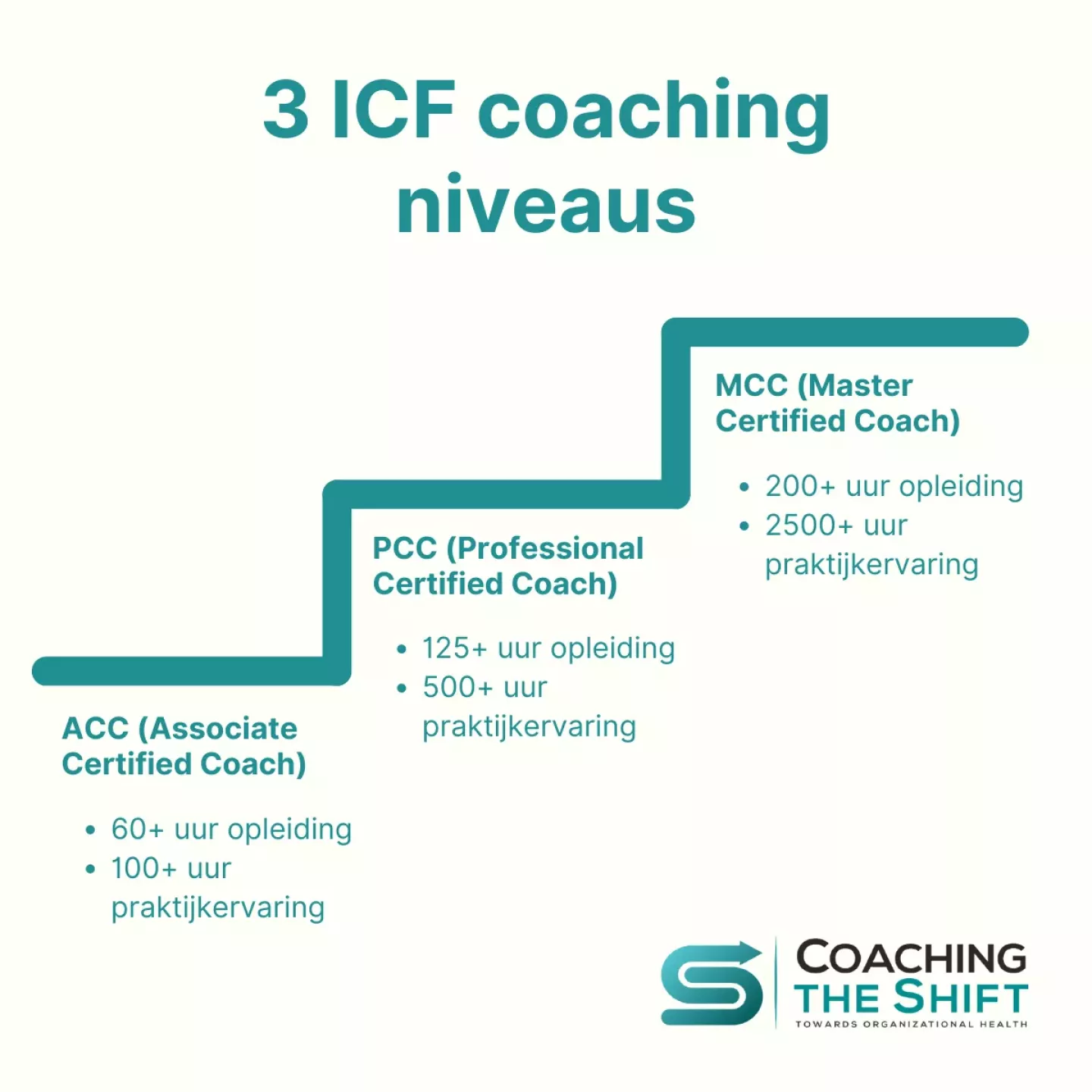
To become an Associate Certified Coach (ACC), you need 60 hours of coach training. In addition, you must have completed 100 hours of effective coaching experience, of which 70 hours are paid, as well as 10 hours of coach mentoring.
Next is the PCC – Professional Certified Coach level. For this credential, you must complete at least 125 hours of coach training, along with more than 500 hours of coaching practice, of which 440 hours are paid.
Finally, there is MCC – Master Certified Coach. These coaches have completed more than 200 hours of coach training. The minimum required coaching experience is 2,500 hours, of which 2,200 hours are paid, with at least 35 different clients.
Coaching is—and always will be—a craft. By committing yourself to continuous personal growth as a coach, you truly set yourself apart. Becoming an MCC does not mean that growth stops; on the contrary, it offers the opportunity to keep expanding your knowledge and to reflect on thousands of hours of experience, feedback, and results.
Set yourself apart and become a professional coach!
The coaching program of Coaching The Shift is the ideal preparation to become an ICF-accredited coach. The program is recognized by the International Coaching Federation (ICF) as an ACTP program, enabling you to achieve both ACC and PCC levels.
All learning outcomes are fully aligned with the ICF core coaching competencies. The program focuses strongly on your development as a coach and is led by three experienced coaches, including MCC coaches, each with more than 5,000 hours of practical coaching experience.
They guide you through an intensive program that combines a dynamic mix of learning formats to keep the experience engaging and fresh. These include video recordings, live demonstrations, role plays, creative thinking exercises, walking exercises, and more.
In addition to theory, there is extensive room for practice. The program includes four half-day sessions dedicated to observing coaching conversations and exchanging feedback.
Finally, you also receive mentor coaching sessions yourself. In these sessions, you work on your own themes and objectives. The mentor coach works at the level of beliefs and identity, supporting you in achieving genuine personal breakthroughs.
As a participant, you will not only experience strong professional growth as a coach, but also gain deeper personal awareness as a human being. It is truly an unforgettable journey—one that leads to remarkable growth and expansion, both professionally and personally.

As you sow, so shall you reap
You don’t become a coach in a single day. As mentioned earlier, coaching is a mindset in which you continue to learn and grow. You can compare it to vegetable gardening. Before you can harvest the fruits, you need patience and must spend a lot of time in the garden.
You can quickly build a raised garden bed, buy a mixed packet of seeds and some chemical quick fixes, and hope for the best. Or you can explore the garden to find the best soil, research which seeds thrive best, and tend to it daily by watering, pruning, and weeding. That’s how you develop a form of permaculture focused on long-term benefits for both the environment and yourself.
Which of the two approaches do you think will yield a better harvest? You will also learn more and enjoy gardening far more when you choose the second path. It is a craft—just like coaching. A personal journey that leads to enrichment and greater focus in life.
Make your personal shift and become a coach in 2022. Explore the possibilities here.