Self-Leadership Guide
Coaching Yourself with the Hero’s Journey
In a world that is moving faster and faster, people want to take control of their own lives again. That is not easy, as change requires courage and perseverance. You can compare it to the Hero’s Journey: a well-known storytelling framework that can also be applied to your personal development. How do you coach yourself through the ups and downs of a development journey? Discover our self-coaching guide!

Johan Van Eeckhout

Learn to coach yourself with our self-leadership guide! In a world that is moving faster and faster, people want to take control of their own lives again. That is not always easy, because it requires change. That is why self-coaching, or personal leadership, is so important. How do you coach yourself through the ups and downs of a development journey?
For this, we use the well-known storytelling framework: the Hero’s Journey — a powerful parallel filled with metaphorical insights and inspiration.
Ready to coach yourself? Discover more:
- What is self-leadership?
- Coaching yourself with the Hero’s Journey
- I The departure: time for change
- II The initiation: a leap into the unknown
- III The return: your new self
What is self-leadership?
Self-leadership is the ability to coach, guide, and motivate yourself without external triggers. This means you decide which goals you want to work toward and achieve them on your own initiative. In other words, you take responsibility for your own life, actions, and results.
Self-leadership or self-coaching does not mean that you have to do everything completely on your own. You can always seek out mentors, allies, and other resources yourself to support and facilitate your development process.

Coaching yourself with the Hero’s Journey
The ability to coach yourself is an important aspect of self-leadership. It includes the skill of observing your own thoughts, feelings, and behavior, and then transforming them. It is about learning from mistakes, recognizing patterns, and developing the competencies and beliefs that support your goals.
The Hero’s Journey is therefore a perfect model for self-coaching. It is an ancient storytelling framework that can be recognized in almost every fictional story. But it does not stop at fiction — in real life, we can also draw many parallels with the Hero’s Journey.
In this model, we recognize the cyclical ups and downs as the feedback loop of life, through which we adjust our thinking, feeling, and actions.
- It helps you better understand your own life story
- You can place challenges, obstacles, and victories into a new perspective more easily
- It helps you recognize and name patterns so you can overcome them
- It helps you develop talents and skills to achieve your goals
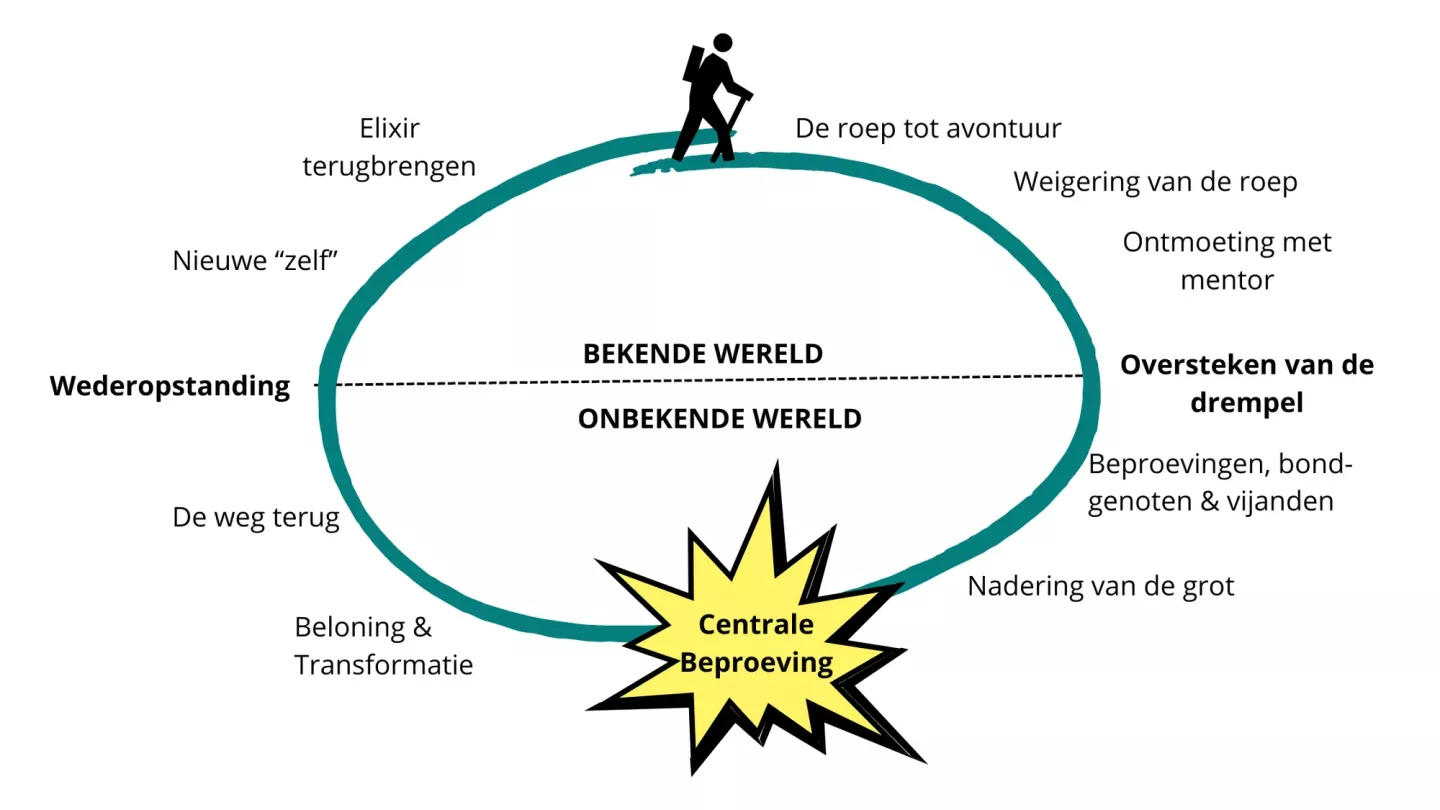
I The Departure: time for change
The Ordinary World
The Hero’s Journey begins with your current reality. What does your situation look like? Where do you feel dissatisfaction? When do you experience stagnation? And where would you like to go? In self-leadership or self-coaching, you regularly reflect on your current situation so you can proactively work on your development.
Example: Liesbeth is a young manager who has enjoyed leading her team for several years. She is highly driven and perfectionistic, with a tendency to do everything herself. This leads to high stress and long working hours. Liesbeth notices she has less and less energy and that she does not give her team members the opportunity to grow.
The Call to Adventure
Next, describe the challenge or problem you want to address. What motivates you to change? Which triggers — both internal and external — initiate your transformation? Through regular reflection and self-coaching, you often become the trigger for your own transformation. However, try not to get stuck in limiting thoughts. Instead, focus on what you truly feel. What do you really want? And what needs to change to create that desired reality?
Example: Liesbeth no longer feels comfortable in her role. She feels like she is constantly falling behind. During a team meeting, her team members express frustration about the lack of delegation. They feel unappreciated and miss opportunities to develop new skills. Liesbeth realizes that something needs to change.
Refusal of the Call
Change is difficult, and resistance is a natural response. But which thoughts, doubts, and fears prevent you from starting your transformation? Which limiting beliefs are (unconsciously and unintentionally) maintaining your current reality?
Example: Liesbeth is afraid to delegate. She fears her team members will not perform the work well and that she might lose her job as a result. She is also afraid of making mistakes and being judged.
Meeting the Mentor
Coaching yourself is not easy. However, you can seek mentors or other resources to support your transformation process. Who or what can guide you? Which role models may have already walked this path before you?
Example: Liesbeth talks with her coach about her fears. The coach helps her realize that she needs to trust her team members and that making mistakes is allowed. The coach also gives her practical tips on how to delegate.
Crossing the Threshold
Eventually, you take the leap. The first steps are often the hardest. We frequently hold ourselves back out of fear of the unknown. Yet these small, concrete actions are what build self-leadership. What is your first step?
Example: Liesbeth decides to start delegating. She begins with small tasks and gradually gives her team members more responsibility.
II The Initiation: a leap into the unknown
Trials, Allies, and Enemies
Soon it becomes clear which obstacles and challenges appear during any transformation process. Sometimes these are colleagues or people in your environment who (unconsciously and unintentionally) help maintain the current reality by planting doubts in your mind. That is why it is important to find allies. Perhaps other managers share the same goal?
Self-leadership also means knowing how to ask for help. By actively seeking role models, mentors, and allies, coaching yourself becomes much easier.
Example: Liesbeth experiences several setbacks. Some team members make mistakes, and she struggles to let go. She also receives criticism from both her team and her manager. At the same time, she finds support from a manager in another office. Together, they discuss the challenges and the motivation behind their development journey.
Approach to the Cave
Coaching yourself requires courage. It is mainly about taking action despite fears and doubts. By doing so, you prevent limiting thoughts from taking over and allow your perspective to expand.
Example: Despite criticism and her fears, Liesbeth learns to release control. She learns to accept mistakes and draw lessons from them, discovering that delegation takes time.
The Central Ordeal
The central ordeal is a key moment in your transformation toward self-leadership. Here, you often overcome your fears and create a new view of reality. What once seemed impossible now becomes possible.
Example: Liesbeth fully entrusts a project to her team. She delegates responsibilities and consciously chooses not to interfere. Through this, she overcomes her fear and realizes she can trust her team members.
Reward
The reward does not necessarily lie in the outcome but in the transformation itself. Throughout the Hero’s Journey, you gain insights, skills, and lessons that make you a stronger leader and person. The feeling of autonomy, progress, and mastery — that is self-leadership.
Example: Liesbeth receives compliments from senior management. She feels proud of her team and herself. She has learned to delegate and gained more confidence in her abilities. The true reward lies not in external validation, but in the new skills and beliefs she developed that led to a breakthrough.
III The Return: your new self
The Road Back
Eventually, you return to everyday life. But how will you integrate this transformation into your daily routine? People often fall back into old habits. To anchor your transformation and self-leadership, you must consciously reinforce new habits and beliefs.
Example: Liesbeth delegates more frequently and gives her team greater responsibility. She experiences less stress and has more time for herself. In her personal life, she also becomes better at sharing responsibilities. She acts more assertively and regularly reminds herself of the importance and benefits of delegation. This improves her work–life balance while increasing her team’s competence and engagement.
Resurrection
You return renewed — your “new self,” enriched with experience, wisdom, and insight. You are still the same person, but with more tools and perspective. Perhaps you have overcome limiting beliefs, or repeated successes have strengthened your confidence and self-image.
Example: Liesbeth has become a stronger and more confident manager. She is now a better leader and has built a stronger relationship with her team. The experience taught her that she can coach herself and that every path to success includes ups and downs.
Bringing Back the Elixir
Finally comes sharing the lessons learned. Here, self-leadership evolves into transformational leadership. You use your experiences and personal growth to help others transform. How will you share your journey? What can you do, from your position as the “hero,” to inspire others?
Example: Liesbeth shares her experiences with other managers and inspires them to delegate. She shares tools, tips, and pitfalls that helped her along her development journey. By being open, Liesbeth becomes a role model who builds trust. If she can do it, others can too.

In short, self-leadership or self-coaching is a process comparable to the Hero’s Journey. In fact, it is a cycle. After overcoming one challenge, a new one quickly presents itself. Becoming aware of this transformation process helps us understand it better, allowing you to coach yourself toward your desired reality. When you realize that there are no “ups” without “downs,” even more possibilities emerge from life — behind every difficulty lies an opportunity.
Veelgestelde vragen over zelfleiderschap
Inschrijven voor onze nieuwsbrief?
Other relevant articles



Self-management in 4 steps The pitfalls and success factors behind self-managing teams