Deep Reflection: Discover the Power of Korthagen’s Cycle
Never underestimate the power of reflection for self-development! Many reflection models, such as Korthagen’s Cycle, are built on learning from experience. The more you repeat the cycle of experimenting and reflecting, the faster and more consciously you move through the learning process. But what about our hidden qualities or obstacles? Learn how to reflect deeply and masterfully in this blog!

Marijke Van Moldergem

Fred Korthagen is a Dutch teacher, educational developer, and consultant. He is best known for his work and book The Power of Reflection, from which two well-known reflection models originate. On the one hand, Korthagen’s Cycle helps people learn more consciously and therefore more effectively. On the other hand, there is the U-I model, in which Korthagen introduced core reflection to enable deeper self-reflection.
How does self-reflection accelerate your learning and development process? Discover it in this article!
- Korthagen’s reflection models
- Korthagen’s Cycle: the spiral model
- Core reflection: Korthagen’s U-I model
- Transformation from within
Korthagen’s reflection models
Korthagen’s reflection models provide a structured approach to self-reflection and analysis. They are used by professionals and students to learn more consciously and deeply. These models promote self-awareness, growth, and development by encouraging reflection on behavior, motivations, and inner patterns.
The two main models are:
- Korthagen’s Cycle, or the spiral model for self-reflection
- Korthagen’s U-I model for core reflection
Both reflection models complement each other in increasing awareness. On the one hand, you reflect on past experiences, examining the relationship between your actions and the desired outcomes. On the other hand, you dive deeper, exploring underlying patterns and ways to transform from within.
Korthagen’s Cycle: the spiral model
Korthagen’s Cycle represents a process that (often unconsciously) shapes our thoughts, actions, and therefore our reality. You move through five recurring steps that increase insight and awareness. Based on the outcomes of earlier cycles, you continuously adjust your actions in future situations.
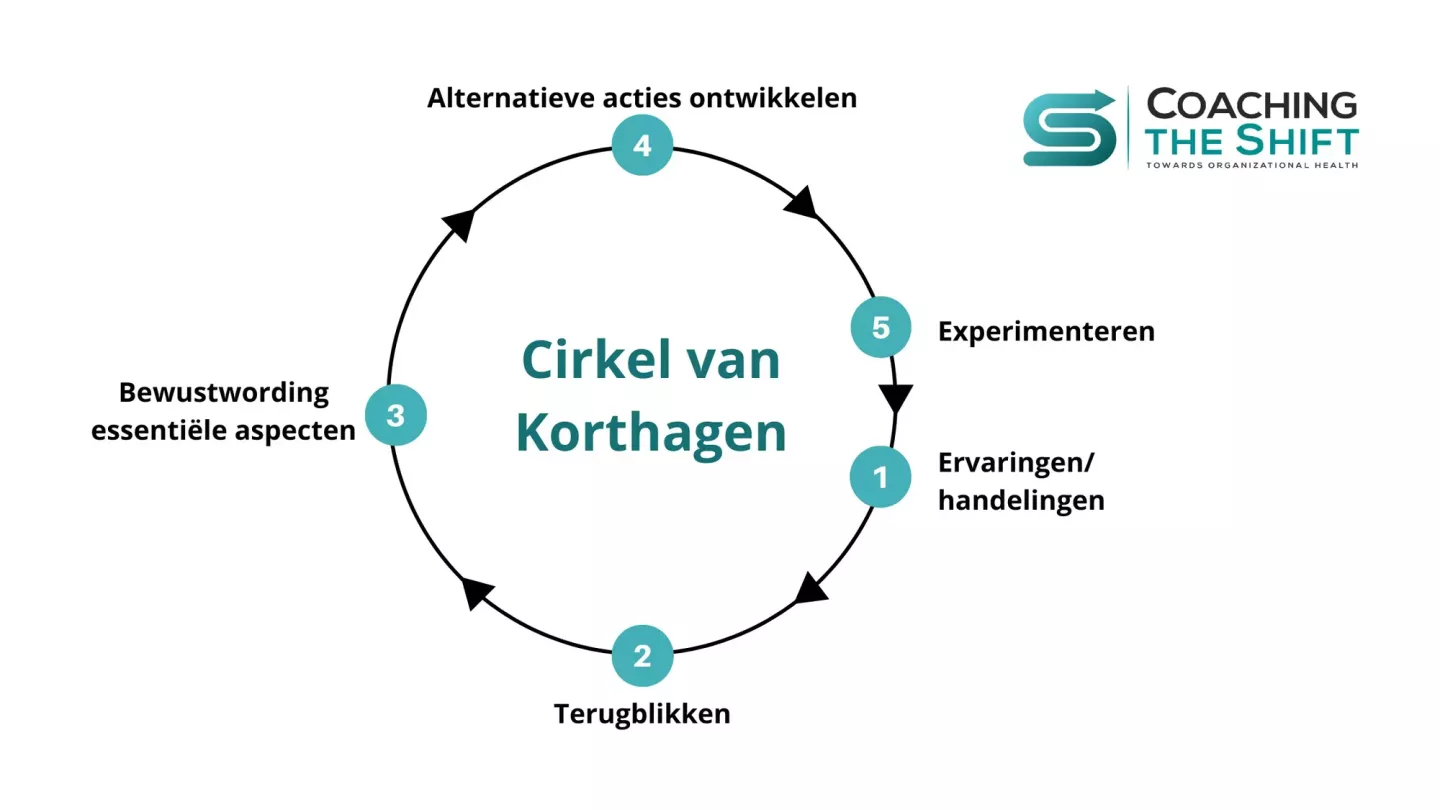
Korthagen’s Cycle: the spiral model
Korthagen’s Cycle, also known as the spiral model, consists of five steps:
- Experience – You have an experience, encounter a situation, or take a specific action. This can be something you do or observe (seeing, hearing, feeling).
- Looking back – The second step is reflection. You look back at the experience and its outcomes. What went well and what did not?
- Awareness – In this phase, also called core reflection, you explore your thoughts and feelings during the experience more deeply. You engage in deep self-reflection and analyze the invisible beliefs and motivations underlying your behavior.
- Developing alternatives – Different results require different actions. Here, you think of alternative approaches for handling similar situations in the future.
- Experimenting – Finally, you apply these insights and alternative actions in practice. You can only know whether something works by actually doing it. This leads to new experiences, and the cycle begins again.
Korthagen’s reflection models encourage self-reflection and increase awareness in your thinking, feeling, and acting. The Cycle provides a systematic approach through which you continuously reflect, learn, and grow from experience. The more often you move through the spiral model, the greater your (self-)awareness becomes.
Core reflection: Korthagen’s U-I model
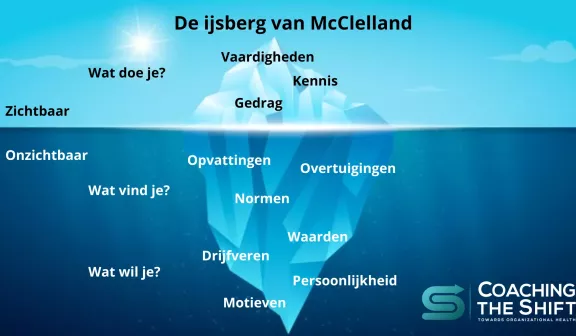
Korthagen’s U-I model supports deep self-reflection, also known as core reflection. In this process, you explore the invisible emotions, beliefs, and motivations that drive your actions and perceptions. In other words, you look beneath the surface — below the waterline.
The U-I model as a reflection framework
The U-I model represents the different layers we do not always consider during self-reflection:
- Environment – How does your current environment influence your behavior and choices?
- Behavior – Which concrete actions do you take (in this situation)?
- Skills – Which skills or techniques do you apply or need to achieve your desired shift?
- Beliefs – Which thoughts and beliefs influence your attitude, choices, and behavior?
- Identity – How do you see yourself as a person (in this situation)?
- Commitment – What are your higher values, vision, and mission?
- Core qualities – Which personal traits and strengths characterize you?
By gaining insight into these different layers, you uncover hidden motivations and patterns that drive your behavior. This not only increases awareness but also creates greater understanding of internal contradictions. For example, our actions may sometimes conflict with our beliefs, which can lead to an uncomfortable or uneasy feeling.
Both reflection models work together to increase awareness and accelerate the learning process. Korthagen’s U-I model helps you experiment and discover proactively. Instead of only changing behavior or environment, you can also work on developing competencies, strengthening supportive beliefs, and transforming your perception.
The U-I model can be compared to other well-known reflection frameworks such as Bateson & Dilts’ Logical Levels, the 5G model, or David McClelland’s Iceberg Model.
Transformation from within
Transformation from within is a journey of self-discovery and personal growth that goes beyond superficial change. It begins with the courage to look deeper — through reflection, self-inquiry, and questioning: Who are you truly, and who do you want to become?
By aligning your values, mission, and vision with your reality and behavior, harmony emerges between who you are and who you aspire to be. You become aligned with the person you truly want to be deep inside.
It is important to start from positive goals rather than avoidance behavior. This solution-focused mindset builds on your core qualities, enabling you to discover and use your unique strengths. This inner shift resonates across different levels of your being, creating a domino effect in behavior, emotions, and patterns.
Core transformation and analysis not only provide understanding but also make change actionable. You can identify unconscious limiting beliefs and replace them with empowering ones that strengthen your energy and self-confidence. It becomes a process of transformation, empowerment, and self-realization.
Although reflection models such as Korthagen’s offer a structured approach, reflection remains a lifelong journey of introspection and inner change. Working with a coach can provide an additional perspective and uncover insights that might otherwise remain hidden.
Will you become the director of your own life? Book a free discovery session!
Veelgestelde vragen over Cirkel van Korthagen & Reflectiemodellen
Inschrijven voor onze nieuwsbrief?