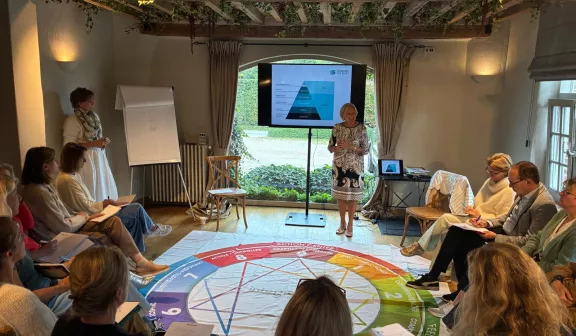
David McClelland’s Iceberg Model
David McClelland’s Iceberg Model distinguishes between what is visible (behavior, competencies) and what is invisible (the underlying layer: beliefs, values). Without understanding your underlying drivers, it is impossible to create sustainable behavioral change.
Eva Buyck

As professional coaches, we understand that personal development is a profound process. David McClelland’s Iceberg Model distinguishes between what is visible (behavior and competencies) and what lies beneath the surface (the underlying layer: beliefs and values). Through his research, McClelland developed not only the iceberg model but also a motivation theory highlighting the importance of human drivers. Without understanding what motivates you, sustainable behavioral change is not possible.
Discover how you can use the iceberg model for reflection, awareness, and change, including coaching questions for each level!
- David McClelland’s motivation theory
- The 4 needs according to David McClelland
- McClelland’s Iceberg Model
David McClelland’s Motivation Theory
David McClelland was an American psychologist best known for his work on motivation theory as well as the Iceberg Model for behavioral change. In his theories, he explored the different (innate) drivers that motivate human behavior.
For his motivation theory, McClelland built upon Maslow’s hierarchy of needs, which organizes fundamental human needs in a hierarchical structure.

Through his research, McClelland identified four additional needs: achievement, influence, connection, and avoidance. The hierarchy of these needs differs from person to person, with each individual typically having one dominant driver. McClelland also emphasized the importance of self-awareness throughout his work, enabling people to use their own psychology to their advantage.
As a coach, this model can be a valuable tool for stimulating personal development. Each need comes with both strengths and potential pitfalls. By understanding your own drivers or needs, you become aware of what to watch out for and how these motivations can support you. In short, this helps you stay motivated throughout the process of behavioral change.
4 Needs According to David McClelland
1. Need for achievement
The need for achievement stems from the desire for feedback. This can take the form of recognition, but also progress or mastery. People with this dominant need tend to set ambitious goals where they can express their creativity. At the same time, they often feel a strong sense of responsibility and a constant need for challenge.
2. Need for influence
People with a strong need for influence place great importance on reputation, with status being one expression of it. The reason is simple: we like to feel important, especially within certain contexts. For many professionals, becoming recognized as an authority within their field is a key goal. It positions them as a “thought leader,” enabling them to guide and influence others.
3. Need for connection
Everyone naturally wants to feel included — humans are social beings. We like to feel part of a larger community and may even adapt our behavior to better fit into a group. In his motivation theory, McClelland observed that individuals driven by connection often excel in partnerships and collaboration.
4. Need for avoidance
Later, avoidance behavior was added to the motivation theory — in other words, the flight response in action. Here, people consciously take action to avoid certain situations, such as conflict. Research even shows that for many individuals, the desire to avoid negative outcomes can be a stronger motivator than the prospect of reward. However, too much avoidance can become counterproductive and may lead to stress or burnout.
For coaches aiming to stimulate personal development, recognizing and exploring these needs is essential to creating genuine transformation.
McClelland’s Iceberg Model
David McClelland’s Iceberg Model links behavior to unconscious beliefs and underlying drivers. In this way, it helps facilitate behavioral change at a deeper level.

The iceberg model is a metaphor. Just like an iceberg, we only see the tip of individuals, teams, or organizations, while what lies beneath the waterline remains invisible. Yet the largest part of the iceberg is hidden below the surface.
In other words, when we think about behavioral change, we often imagine making a simple decision and changing habits through discipline and willpower alone. However, behind behavior lies a set of invisible and often unconscious beliefs, motivations, values, and drivers that shape it. To achieve sustainable change, you therefore need to explore what lies beneath the surface.

If you coach people in personal development, the iceberg model offers not only insight but also practical guidance to start meaningful conversations with clients about the deeper layers behind their behavior.
Discover more models like McClelland’s Iceberg Model to support your development as a coach!
Visible – above the waterline
What do you do? — Doing
Above the waterline lies everything that is visible or observable. This includes all forms of (inter)action: behavior, skills, and knowledge. For coaches, this is often a good starting point for personal development before exploring deeper layers together.
In organizations, this level includes elements such as job descriptions, organizational structures, and work procedures.
Behavior
- What are you doing now? Why do you behave this way?
- What are the consequences of this behavior? What are the desired and undesired results?
- Which behaviors unconsciously maintain your current reality?
- What have you already tried? How did it go?
Competencies
- What can you already do?
- What are your strengths?
- Which areas still need development?
- What can you not yet do?
- Do you have relevant experiences?
Knowledge
- What do you already know?
- Do you know enough to take action?
- What do you still not know?
- Where could you gain additional knowledge?
Solving problems at the visible level usually focuses on situational change — adjusting behavior or the environment to achieve different results. This is often referred to as single-loop learning.
However, the visible layer only tells part of the story. Behavior is guided by (often unconscious) beliefs, motives, and values beneath the surface.
Invisible – the underlying layer
The underlying layer feeds the visible layer and can either limit or empower behavior. Self-sabotaging behavior often originates from underlying beliefs, which can restrict personal development.
In organizations, unwritten rules, habits, and rituals belong to this hidden layer. Although unofficial, they strongly influence company culture. That is why both cultural and behavioral change require a shift in thinking and being.
What do you think? — Thinking
The first layer beneath the waterline concerns thoughts: what you believe, what you value, and where these ideas come from. How we think shapes both our behavior and our self-image.
Beliefs
- What do you believe? Where does this belief come from?
- Why do you think this way?
- How do these beliefs support your goals?
- What could you gain by looking at this differently?
- Are these beliefs based on reality or perception?
Norms and values
- What behavior do you consider appropriate or inappropriate?
- In which situations do you feel disappointed or frustrated? Why?
- What are your ideals? What change would you like to see?
- Which values would you stand up for? What would you lose if you didn’t?
- How important are these values to you?
- Are there things that block you?
Self-image
- What do you think about yourself?
- How do you believe others see you?
- What doubts or fears do you have?
- Are certain needs unmet?
- How does this hold you back?
At this level, behavioral change occurs through a new way of thinking — for example, replacing limiting beliefs with empowering ones or shifting perception. This is often called double-loop learning.
What do you want? — Feeling
The deepest layer of McClelland’s Iceberg Model focuses on what you want and feel — in other words, why you do what you do. These drivers shape our personality and identity, often unconsciously.
Drivers and motives
- What gives you energy? What do you enjoy?
- What do you truly want to do?
- What matters most in your life, work, or relationships?
- What do you absolutely not want to do? Why?
- What motivates you? What are your passions, interests, and dreams?
- If nothing held you back, what would you do?
Personality
- Is your behavior an automatic response?
- Does this behavior pattern occur frequently?
- What do you stand for? How would you describe yourself?
- What topics matter to you? What are your views and opinions?
- Who do you admire and why?
- What do you dislike strongly?
- What have you inherited from your upbringing? How are you different?
- Which moments in your life were defining?
At this deepest level, behavioral change takes place at the level of identity. The deeper you go into the iceberg, the more complex change becomes. It requires time and incremental action to anchor a new identity. Often, this transformation emerges as a response to meaningful life events or sustained personal development.
The process begins with awareness and reflection. Over time, shifts in behavior influence thinking and identity — a process sometimes referred to as triple-loop learning.
Related articles and coaching models on personal development & behavioral change
- Single, double, triple loop learning
- Denken, voelen, doen
- Bateson’s 6 Logical Levels
Veelgestelde vragen over: het ijsbergmodel van David McClelland
Inschrijven voor onze nieuwbrief?
Other relevant articles




Obstakels als springplank voor ontwikkeling Mentale blokkades doorbreken in 5 stappen!