What is your deepest driver?
The Enneagram and the path to self-acceptance

Dorothée Willems

Recently, we hosted an inspiring session on the Enneagram within the Shift & Grow community, and the turnout was overwhelming. The high level of interest did not surprise us. Tools like the Enneagram go straight to the core of who we are: identity.
In a world of constant change and increasing automation, it is precisely our human factor—our deepest why—that remains our added value. The Enneagram helps to unravel this, beyond behavior and competencies. It goes deeper than simply “what do you typically do?” and touches on “why do you actually do it?”
In this article, we explore:
- The Enneagram: its origins and evolution
- What the Enneagram tells us about our drivers
- The Driver Paradox
- The path of development: seeing, understanding, embracing
- The Enneagram as a compass for organizations and teams
The Enneagram: origins and evolution
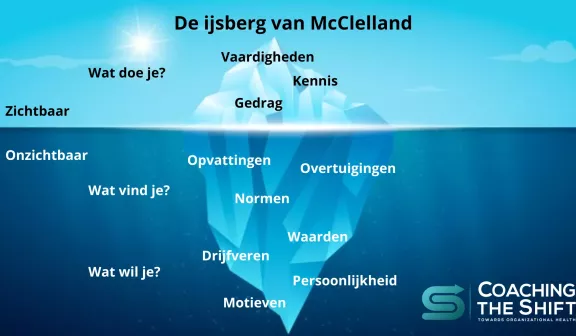
The Enneagram is an ancient system that dates back to figures such as Pythagoras and Zarathustra, and was rediscovered and further developed in modern times by mystics and psychologists. At its core, it proposes that there are nine essential drivers. It points to the deepest known layer—what lies beneath the surface, below the waterline of the iceberg.
These drivers are neither purely innate nor purely learned. As discussed during the session, they are a blend of nature and nurture. We are born with a certain essence, which is then shaped, strengthened, or restrained by our upbringing and the experiences we encounter throughout life. As a result, we identify with an idealized self-image. This self-image becomes the starting point of our automatic patterns—the mechanisms we unconsciously keep in place.

What the Enneagram tells us about our drivers
This system goes deeper than behavioral models such as Insights Discovery, which mainly focus on behavior within a specific context. The Enneagram works at the level of identity and zooms in on the deepest, intrinsic motivators that are shaped—or suppressed—very early in our lives, often already in infancy. It offers a way into something that can be put into words, yet fundamentally exists at an identity level.
Within the Enneagram, the foundation of our identity and motivation is divided into three centers:
- Gut center (Action) – core emotion: anger
- Heart center (Feeling) – core emotion: sadness
- Head center (Thinking) – core emotion: fear
What stands out is that our deepest motivators are often not positive drivers, but rather a moving away from the core emotion. In the Enneagram, the origin of this is linked to early, unconscious experiences of lack or deficiency, often already in childhood. This deeply rooted sense of unsafety or incompleteness becomes the driving force behind our automatic reactions.
The Driver Paradox
This deep, unconscious sense of lack feeds the beliefs we form to protect ourselves. Take, for example, Type Nine, the Peacemaker, who is driven by a desire for harmony. The intention is often well-meaning, but the driver arises from a lack of inner harmony.
This results in an externally focused perspective: doing everything possible to please others and “do good.” The irony is that if the Nine remains unaware of this pattern, they will continue to experience a lack of harmony. The paradox, then, is that the very mechanism we unconsciously keep feeding produces the opposite of what we truly desire.
As long as we are unaware of this mechanism, we keep falling into the same trap. As Christine illustrated with the poem by Portia Nelson:

This poem perfectly illustrates how, even when we have insight, we still tend to fall into the same pit again and again. It is familiar—it is our well-known path. The real art lies in making a conscious choice and daring to step off that path.
The development path: seeing, understanding, embracing
Personal development through the lens of the Enneagram is a journey of awareness and acceptance. It consists of three essential steps:
1. Seeing and understanding
The first step is to look honestly in the mirror. What is my deepest inner driver? What triggers me? Many people hold strong judgments about their own identity and therefore avoid seeing or accepting it.
A useful way to step out of compulsive patterns is to apply a coaching principle: “How would another type respond to this?” By imagining yourself in a different role, you interrupt your habitual pattern.
2. Appreciating the strength
Once you recognize your identification, the second step becomes crucial: learning to appreciate its strength. Every driver is polar—it has both a positive and a negative side. A Type Three (achievement-oriented), for example, can be incredibly productive and motivating. The key question becomes: when is this productive, and when does it become counterproductive?
This is the pause button: recognizing when you are slipping into a pitfall and then consciously choosing a different path.
3. Embracing and letting go
The third—and perhaps most challenging—step is embracing your driver. It is about “accepting what is.” You cannot remove the pit from the road; you can only consciously choose to walk around it. Letting go of judgment often creates a sense of calm.
This means taking small steps that go against your habits. Think of the achievement-driven Type Three learning that they also have value even when they are not producing results. These small, conscious choices break compulsive patterns and stop you from feeding a mechanism that ultimately does not give you what you are looking for.
The Enneagram as a compass for organizations and teams
The Enneagram is also a powerful tool for organizations and teams. It goes straight to the root of resistance, miscommunication, and misunderstanding. By understanding why team members react in certain ways, organizations can collaborate more effectively.
A thinker (head center), for example, may rely strongly on logic and reason, while a feeler (heart or gut center) may approach situations from a more human or emotional perspective. Both viewpoints are valuable, yet they can clash. Without awareness, this leads to conflict or people talking past one another.
The Enneagram provides a safe framework to make these differences discussable. By sharing and acknowledging underlying drivers, teams develop greater understanding and empathy. This shifts communication from selective listening to genuine understanding.
Teams also learn to leverage their polarities. A team full of thinkers may be exceptionally clear and analytical, but sometimes miss human connection. A team dominated by feelers may bring strong engagement and intuition, yet delay rational decision-making. When both perspectives are consciously integrated, a balance emerges that is both productive and human-centered.
From labels to ownership
The business world is undergoing a major shift. As technologies such as AI and automation increasingly take over rational thinking tasks, human value is moving toward awareness, meaning, and connection.
What truly distinguishes people today lies in:
- Self-awareness: insight into your own drivers, emotions, and automatic patterns, and the ability to regulate them.
- Social awareness: empathy and the ability to perceive the emotions, needs, and perspectives of others.
- Relational awareness: building meaningful relationships and connections—not only within teams, but also with the broader societal systems in which organizations operate.
The Enneagram is not a labeling system; it is an invitation to take ownership of your deepest motivations and to recognize that, in the present moment, you can choose differently. Instead of remaining stuck when you fall into the pit, you learn—through empathy—to choose a new path.
Looking for a community that challenges and inspires you as a coach? Discover the Shift & Grow community—for coaches, by coaches.
Veel gestelde vragen over het Enneagram en de weg naar zelfacceptatie
Inschrijven voor onze nieuwsbrief?