Open communication: the heart of a healthy work environment
Open communication is at the heart of development within organizations.
An open dialogue not only fosters personal growth, but also strengthens team dynamics. Yet many organizations still struggle with misconceptions, pitfalls, and obstacles that hinder genuine open communication.
How do you create a safe environment where everything can be discussed—and therefore worked through? Discover it in this blog!

Eva Declercq

Open communication is the fuel of high-performing organizations.
In teams where everything can be discussed, everything becomes workable. Open dialogue not only fosters personal development, but also strengthens team dynamics. By engaging in (sometimes difficult) open conversations, you build a culture of openness, trust, and mutual respect. You create an environment of understanding, where people help one another grow and challenge each other to become the best version of themselves.
How do you facilitate open communication and genuine dialogue within your organization? Discover it in this blog:
- The importance of open communication – Do you dare to engage in dialogue?
- 3 obstacles to open communication in the workplace
- The difference between perception & reality
- Openness opens up: lowering the waterline
- Shift your perception: intention – behavior – impact
The importance of open communication – Do you dare to engage in dialogue?
Open dialogue is a powerful tool for coaches, but also for organizations and leaders who want to make a greater impact. Just like in feedback conversations, the goal is to increase understanding and uncover invisible factors or blind spots. After all, making something discussable also makes it workable.
A dialogue is a conversation aimed at creating mutual understanding in a respectful way. Openness also means revealing your own thoughts, feelings, and behavior, while at the same time being open to what the other person reveals. How do you explore this behavior in order to better understand the other?
In short, open dialogue—or open communication—is about creating mutual understanding in a safe environment where trust and mutual respect come first. Dialogue is about sharing meaning. You go beyond what is said or done and dive into the underlying intentions, drivers, and emotions that guide behavior.
3 obstacles to open communication in the workplace
Although open communication is a goal for many organizations, reality often still falls short. There are several reasons why people avoid open conversations:
- Poor relationships: Strained relationships create distance, while closeness is crucial to resolving conflict.
- Need for speed: There is often too little time within organizations to engage in genuine open dialogue. Sometimes this is indeed the case, especially for busy managers.
- Ego: The perception we have of ourselves and the fear of being judged negatively by others. For example: “If I ask this question, they might think I’m incompetent.”
Facilitating a safe environment and building trust are therefore essential to encouraging open dialogue.
The difference between perception & reality
Is the glass half empty or half full? Perception is a choice—one we often make unconsciously. You decide whether the glass is half empty or half full. People tend to fill in and interpret situations based on their own worldview, yet everyone sees things differently. Two people may do the same thing, but for very different reasons.
For example, what do you think when you can’t reach your manager or supervisor? What assumptions arise?
- He doesn’t have time for me
- He’s not interested anyway
- Our team isn’t important enough
- …
The manager, however, may have a completely different perspective:
- My employee is doing well; I’ll let them continue working
- My team likes to work independently; I won’t interfere too much
- The team knows they can always reach me
- …

Both parties have a completely different perception, yet they live in the same reality.
The only way to resolve this is through open communication. This creates greater understanding on both sides. There is no point in remaining stuck in your own limited perception—don’t make assumptions. Instead, dare to dive below the waterline. Ask yourself: what lies behind this behavior? What is this a symptom of?
Openness opens up: lowering the waterline
Two monologues do not make a dialogue. Both parties must dare to open themselves up. You listen with the desire to understand, not with the intention to convince.
The best way to initiate an open dialogue is to start by opening yourself. By showing vulnerability and being transparent, you give the other person permission to do the same. When both parties lower their waterline, deeper insight emerges into the underlying intentions and drivers behind behavior.
- Dare to share what you think, feel, and do – openness opens up.
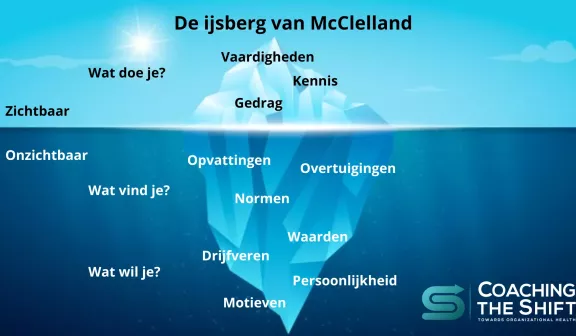
Often, we only see the tip of the iceberg. By lowering the water level, both parties gain a better understanding of each other’s behavior—and its impact on themselves, the environment, and results. - Increase understanding – Both parties gain insight into underlying intentions. Are you the manager in the scenario above? Try to understand why employees feel the way they do. Then, look for solutions together: what can you, as a leader, do to support your team in the best possible way?
- Avoid projection – The same behavior does not always stem from the same intention. Be aware that everyone has their own frame of reference. Instead of projecting assumptions, bring them into the conversation as hypotheses and explore the response more deeply.

Open dialogue is, above all, about listening.
You want to better understand the other person’s perception. You do this by listening sincerely and asking follow-up questions. Once you open yourself up—and dare to engage in dialogue—you can increase the other person’s understanding and adjust your communication style accordingly.
Discover more about the power of Open Dialogue & Communication during a tailor-made inspirational session!
Shift your perception: Intention – Behavior – Impact
Everyone has their own iceberg (frame of reference or worldview) that drives their behavior. And the way we interact with each other, in turn, influences that framework—it’s a continuous interaction. But how can you step out of the vicious cycle of drama by increasing your understanding?
Challenge yourself to think differently. When you notice a negative perception, look for the underlying positive intention. For example, how could you look differently at the following?
My manager is…
- Bossy
- Absent
- Present
- Steadfast
- Perfectionistic
- … (add your own example)
Always search for the underlying positive intention. Or when you notice yourself slipping into a judging mindset, pause for a moment and ask yourself:
- Action: What does this person (your manager) do or say that gives me this impression?
- Impact: What is the effect of this on me?
- Intention: What possible positive intention might lie behind this?
- Shift perception: Reframe your perspective—how could you look at this differently?
Let open communication be the guiding principle in your daily interactions. By being aware of obstacles and pitfalls, and by actively paying attention to your own perception, you can create a culture of openness and understanding. This not only leads to better-performing teams, but also to a healthier and more enjoyable work environment.
Are you also building a coaching culture? Develop the fundamental skills with the Coaching Skill Foundations program!
Veelgestelde vragen over open communicatie op de werkvloer
Inschrijven voor onze nieuwsbrief?
Other relevant articles


Obstakels als springplank voor ontwikkeling Mentale blokkades doorbreken in 5 stappen!