Emotional reflection: the key to empathy and understanding in every conversation!
Effective communication is crucial to the success of any organization. And among all communication skills, one stands out: listening. But what makes someone a good listener? And how can you use emotional awareness to build a deeper relationship of trust? Discover more about emotional reflection and different conversational techniques in this blog!
Johan Van Eeckhout

Effective communication is crucial to your success. Although many skills contribute to clear communication, one stands out: listening. But what makes active listening so important? And how can you take your listening skills to the next level? In this blog, we explore the power of reflective listening as a communication skill and introduce conversational techniques such as emotional reflection.
- What is emotional reflection?
- The art of emotional reflection
- Reflective listening & emotional reflection: a step-by-step approach
- 7 reflective conversation techniques
- How emotional reflection can make a difference
What is emotional reflection?
Emotional reflection, or reflective listening, is a conversational technique and listening skill in which you mirror perceived emotions by introducing them as a hypothesis within the conversation. It is a powerful tool for leaders and coaches because it helps them better understand the emotions and perspectives of their team members.
On one hand, reflective listening shows that you are attentive and genuinely trying to understand what the other person is saying. On the other hand, emotional reflection allows you to use your intuition to name what may remain unspoken. This can help conversations reach the core of the issue more quickly.
The art of emotional reflection
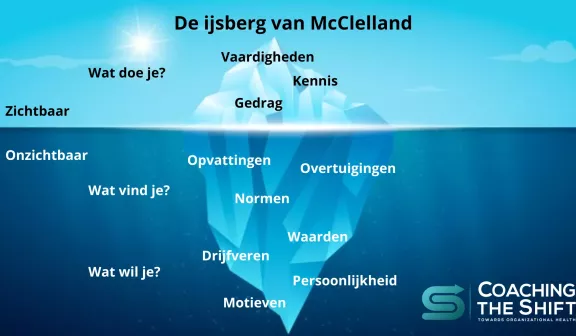
A conversation is not only about what is said, but also about the invisible signals beneath the surface. With the right conversational techniques, an experienced coach can help you look below the waterline and move closer to the essence of the situation. This creates awareness beyond the literal words and brings attention to what is present but not yet visible.

As an experienced coach, you have the ability to integrate emotional signals into your conversations. There are two ways to do this.
1) Sharing your own feelings with the other person
Sometimes, during a conversation, you can use your own feelings or intuition to bring unspoken dynamics to the surface. It is important to introduce your feelings as a hypothesis rather than a certainty. By reflecting your own feelings, you show openness and vulnerability, which helps build trust. At the same time, your assumptions can be confirmed or challenged, allowing for a deeper exchange of thoughts and emotions.
Example:
During a conversation with an employee, their direct manager, and the senior manager (N+2), I noticed that whenever I asked a question, the senior manager answered on behalf of the direct manager. When I shared my feeling as a hypothesis, the response was: “The manager avoids discussions and rarely speaks up himself. That’s why I’m here to guide the conversation.”
By exploring this further, we discovered that the senior manager was partly contributing to the issue. Unconsciously and unintentionally, he was reinforcing the current reality. As a result, the manager could not step outside their comfort zone or work toward their learning goals. This insight only emerged because I introduced my intuition and feelings into the conversation.
2) Naming the other person’s feelings
At times, you may also infer emotions from your conversation partner by paying close attention to facial expressions, body language, tone, and word choice. Again, these observations should be introduced as hypotheses.
By reflecting the other person’s feelings, you demonstrate active listening and create a safe space in which the other person feels invited to share openly.

Both conversational techniques contribute to building effective communication and creating a trusting environment. This allows an open dialogue to emerge, enabling people to better understand each other’s underlying emotions and needs — and respond to them accordingly. It is important, however, to remain aware of potential pitfalls such as assumptions, incorrect interpretations, and overgeneralization.
Reflective listening & emotional reflection: a step-by-step approach
Emotional reflection increases empathy, deepens communication, and transforms unproductive conflicts into open conversations. By openly sharing feelings, you create space for mutual understanding and the discovery of common ground.
There are also some pitfalls to emotional reflection, which is why it is important to follow these five steps when reflecting feelings:
1) Ask for permission
Start by asking permission to share an observation or introduce something into the conversation. This creates an atmosphere of respect and openness, helping the other person feel safe to engage.
2) Introduce a feeling hypothesis
Present your observation as a hypothesis rather than a fact. For example:
“I have the feeling that…” or “It seems to me that…”
Remain neutral and objective. This gives the other person space to confirm or correct your perception without feeling judged or attacked.
3) Ask a reflective question
Invite your conversation partner to explore their thoughts and feelings. For example:
“What do you think about this?” or “How do you see this?”
This encourages deeper exploration and dialogue.
4) Apply LSD techniques
Use the LSD conversation skills: Listen – Summarize – Dare to ask (follow-up questions).
- Listening helps you notice emotional signals in yourself and the other person.
- Summarizing clears up misunderstandings or assumptions.
- Daring to ask deepens insight into hidden patterns and underlying beliefs.
“If you want to get high off conversations, try using some LSD! (Listen – Summarize – Dare to ask)”
Ultimately, this leads back to the power of full presence. With experience and practice, coaches develop sharper perception and intuition, making it easier to notice — or even sense — what remains unspoken.
7 reflective conversation techniques
There are several ways to practice reflective listening:
- 1. Simple reflection (paraphrasing)
You repeat or rephrase the speaker’s words to show understanding.
Example: “You’re saying that…” - 2. Double-sided reflection
You name two seemingly conflicting feelings or perspectives expressed by the speaker, helping explore ambivalence.
Example: “So you want to…, but at the same time you…” - 3. Complex reflection
You articulate what the other person is trying to express, even when they struggle to find the right words.
Example: “Do you mean that…?” - 4. Emotional reflection
You name emotions — your own or the other person’s — that arise during the conversation. This builds trust and psychological safety.
Example: “I have the feeling that… Is that right?” - 5. Amplified reflection
You deliberately emphasize a specific aspect (such as resistance) to invite nuance or deeper reflection.
Example: “It sounds like this feels like the only possible option for you?” - 6. Minimizing reflection
The opposite of amplification: you intentionally downplay an aspect to encourage the speaker to strengthen or clarify their message.
Example: “It seems like this isn’t that important to you?” - 7. Linking reflection
You connect something the speaker says to an earlier moment or emotion in the conversation, creating coherence and continuity.
Example: “Earlier you mentioned… could these be connected?”

How emotional reflection can make a difference
Reflective listening and emotional reflection are two conversational techniques that go hand in hand in fostering effective — or even transformational — dialogue. They involve not only hearing the other person’s words, but also understanding what lies beneath them, including feelings, needs, and intentions.
By openly sharing emotions during a conversation, you create an atmosphere of mutual understanding and deeper insight into each other’s underlying thoughts and emotions. When applied effectively, emotional reflection enables more meaningful communication and helps build stronger relationships with the people around us — both in personal and professional contexts.
Veelgestelde vragen over Gevoelsreflectie & Reflectief Luisteren
Inschrijven voor onze nieuwsbrief?
Other relevant articles