The art of productive discussion:
5 Thomas-Kilmann conflict styles in action!
Dealing with conflict: How do you turn conflict situations into opportunities for growth? The 5 Thomas–Kilmann conflict styles define five approaches to handling conflict. How do you remain assertive in defending your interests without escalating the conflict? And even more importantly, what can you do to create a win-win situation?
Magaly De Smet

Effectively dealing with conflict is a crucial skill for successful collaboration. In fact, conflict situations offer constructive opportunities for growth and change. That is why it is an important part of our team coaching training.
However, finding the right approach to conflict management and resolution often remains a challenge. Gain more insight with the conflict model and the 5 Thomas–Kilmann conflict styles!
- How do you find a balance between pursuing your own interests and respecting the interests of others?
- How do conflict situations arise?
- The 5 Thomas–Kilmann conflict styles
- Kilmann’s conflict management model
How do conflict situations arise?
According to Kilmann’s conflict model, conflict situations arise when two or more people have opposing interests. However, conflict is not the same as drama. The way the people involved handle conflict does have a significant impact on the outcome for everyone involved.
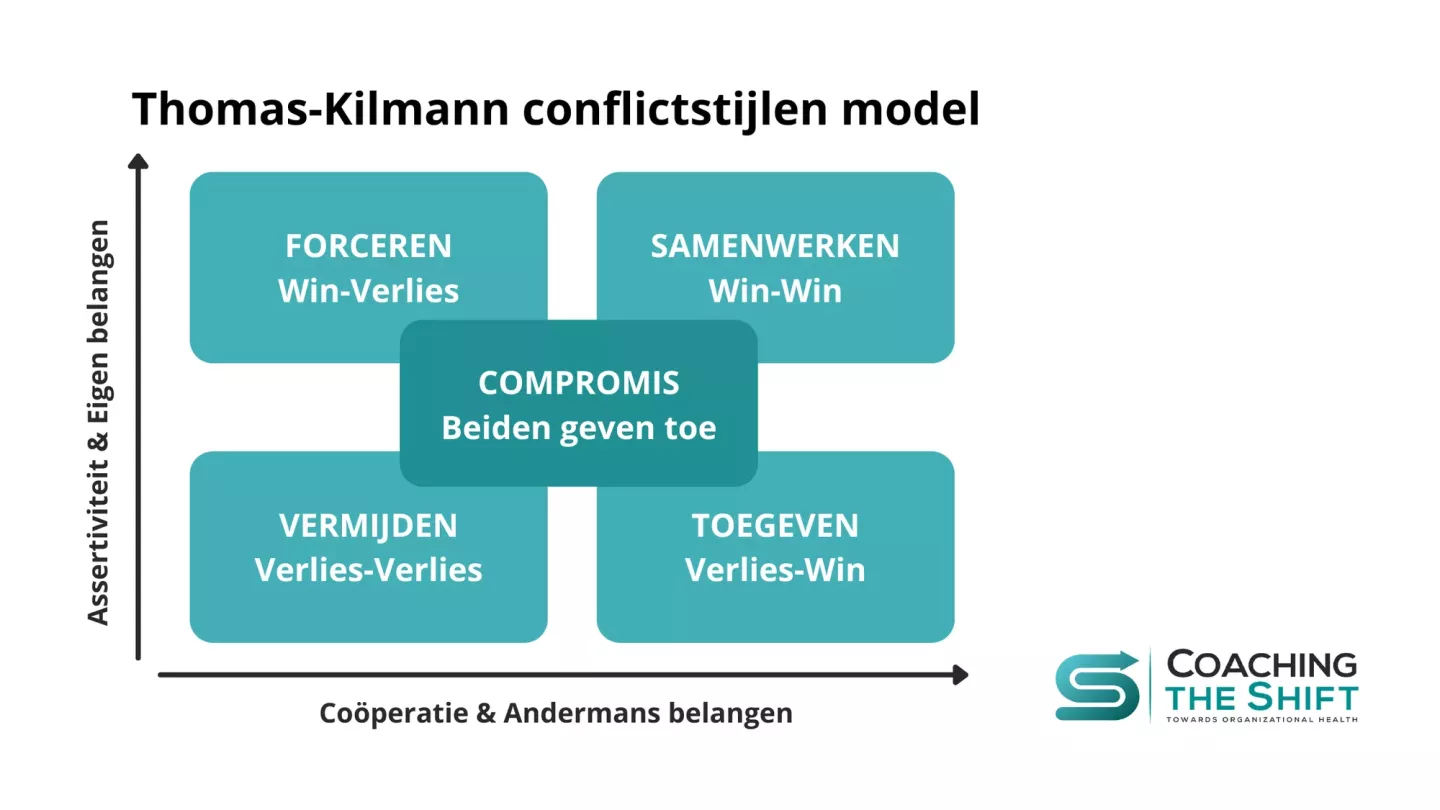
Thomas and Kilmann define five conflict styles, positioning the pursuit of one’s own interests against the degree of cooperation. Depending on the conflict situation, different conflict styles can be applied to achieve win-win or win-lose outcomes. As part of a team or larger whole, it may sometimes be necessary to place shared interests above your own perspective.
In our team coaching training programs or trajectories, we see that team members often fall back into automatic patterns. We usually unconsciously revert to our preferred style. As a result, we may come across as more aggressive or more passive, and we do not respond optimally to the conflict situation. When unresolved or unspoken conflicts persist, this can ultimately lead to neglect within teams or a loss of motivation.
The 5 Thomas–Kilmann conflict styles
The conflict model includes three natural instincts: fight (competing), flight (avoiding), and freeze (accommodating). In addition, through open dialogue we can collaborate and reach compromises, leading to better outcomes for all parties involved.
The conflict styles are positioned along two axes that balance the interests of those involved:
- Assertiveness: How well do you stand up for your own interests?
- Cooperativeness: How well do you take care of others’ interests?

By being aware of the different conflict styles and their applications, you can respond more effectively to various conflict situations. This helps you handle conflicts better and consistently strive for positive outcomes for all parties involved.
In our team coaching training, we therefore focus not only on how you deal with conflicts, but also on how to guide different preferred styles constructively through a discussion.
1) Competing (Win–Lose)
With this conflict style, a person acts firmly and decisively to push through their own position, regardless of opposition.
- Strengths: Effective in emergencies and crises; decisive behavior can trigger immediate action.
- Pitfalls: Can lead to resistance and tension and may damage relationships.
This style is best used when quick decisions or urgent action are required — situations where your own interests are very high but cooperation is less important.
2) Collaborating (Win–Win)
This conflict style involves open communication, finding common ground, and working together to reach a solution acceptable to both parties.
- Strengths: Promotes understanding, strengthens relationships, and generates innovative solutions.
- Pitfalls: Can be time-consuming and difficult when opinions strongly differ.
Use collaboration especially for complex problems requiring creative solutions and when long-term relationships are important. Both your interests and those of the other party are equally valued.
3) Compromising (Win–Win / Lose–Lose)
This style involves both parties giving something up to reach an acceptable solution. It is usually a partial win-win situation where each side makes concessions.
- Strengths: Leads to quick solutions and maintains relationships.
- Pitfalls: May result in suboptimal outcomes and long-term dissatisfaction.
In these situations, it is important to understand your own interests clearly: what is essential, and what can you let go? This style works best when a quick agreement is needed and mutual concessions are possible. It is often difficult to compromise on core values or principles.
4) Avoiding (Win–Lose or Win–Win)
In this conflict style, the conflict is avoided or ignored rather than addressed.
- Strengths: Can temporarily reduce tension and is useful for minor or irrelevant disputes.
- Pitfalls: May lead to unresolved problems, frustration, and suppressed emotions.
In some cases, it can also produce a win-win outcome — for example, when the conflict is not important enough to justify the time investment or when emotions are running too high. Conflict resolution is not always possible when there is no ongoing collaboration with the other party. In such cases, “out of sight, out of mind” may be better than unnecessary discussion.
5) Accommodating (Win–Lose)
In this final conflict style, one party adapts and gives in to the demands of the other.
- Strengths: Can build goodwill and preserve relationships.
- Pitfalls: A lack of assertiveness and boundaries may lead to feelings of unfairness.
This style is useful when maintaining the relationship is more important than winning the conflict — when the relationship matters more than the issue itself.
How productively does your team handle discussions? Discover more with our free Team Scan!
Kilmann’s conflict management model: what you learn in our team coaching training
Understanding and effectively applying the Thomas–Kilmann conflict styles is essential for successful conflict management.
First, the model provides insight into your own preferred conflict styles. This self-awareness helps you recognize your reactions and consciously choose how to deal with conflict. It is also important to understand team dynamics, as different team members often have different preferred styles.
The model emphasizes that the right style varies depending on the situation. It depends on the people involved and the required balance between assertiveness and cooperativeness. Effective conflict management therefore means being able to apply different conflict styles and adapting them to the needs of everyone involved.
The first step in dealing with conflict is recognizing your own role in it. This enables you to develop and refine essential conflict skills such as empathy, active listening, assertive communication, negotiation, and problem-solving. By cultivating these skills, you can transform conflicts into opportunities for growth, understanding, and collaboration.
Turn conflict into opportunity: discover our team coaching training!
Veelgestelde vragen over de kunst van productieve discussie: de 5 Thomas‑Kilmann‑conflictstijlen in actie
Inschrijven voor onze nieuwsbrief?
Other relevant articles