What is personal leadership?
A journey of self-development!
Personal leadership is a path of self-development that leads to a balanced life. Along this journey, you discover yourself — your thoughts, emotions, and beliefs, as well as your talents and growth areas. From this awareness, you create a life aligned with your goals and values. You feel better in your own skin and take ownership of your life.

Magaly De Smet

Personal leadership is a journey of self-development that leads to a more intentional and balanced life. It is a recurring theme in individual coaching trajectories: “I feel like my life is flying by, and I’m constantly trying to catch up.”
Stephen Covey wrote a book in which he defines the seven habits of personal leadership. These habits help you reclaim leadership over your own life — instead of feeling like life is leading you.
Discover more in this article about:
- What is personal leadership?
- Why is personal leadership important?
- What is personal leadership according to Stephen Covey?
- The 7 habits of highly effective people according to Covey
- The 4 energy dimensions for your well-being
What is personal leadership?
Personal leadership means consciously choosing a proactive attitude in your life. You take ownership of your life again. It is a journey of self-discovery and self-development, in which you explore your own emotions, thoughts, and beliefs.
By identifying your talents, strengths, and pitfalls, you learn to act consciously in alignment with your values and vision. This helps you create more balance, energy, self-confidence, and fulfilment in your life.
It is therefore a recurring and important theme within individual coaching trajectories.
Why is personal leadership important?
Today, many people live unconsciously in a stimulus–response mode. Life leads you, instead of the other way around. As a result, you may look at the world through blind spots or unconscious biases that hold you back.
Yet self-development is a fundamental human need. Abraham Maslow placed it at the top of his hierarchy of needs under the concept of self-actualisation. With this, he described the life journey toward becoming the best possible version of yourself. What that destination, journey, or experience looks like differs for everyone.
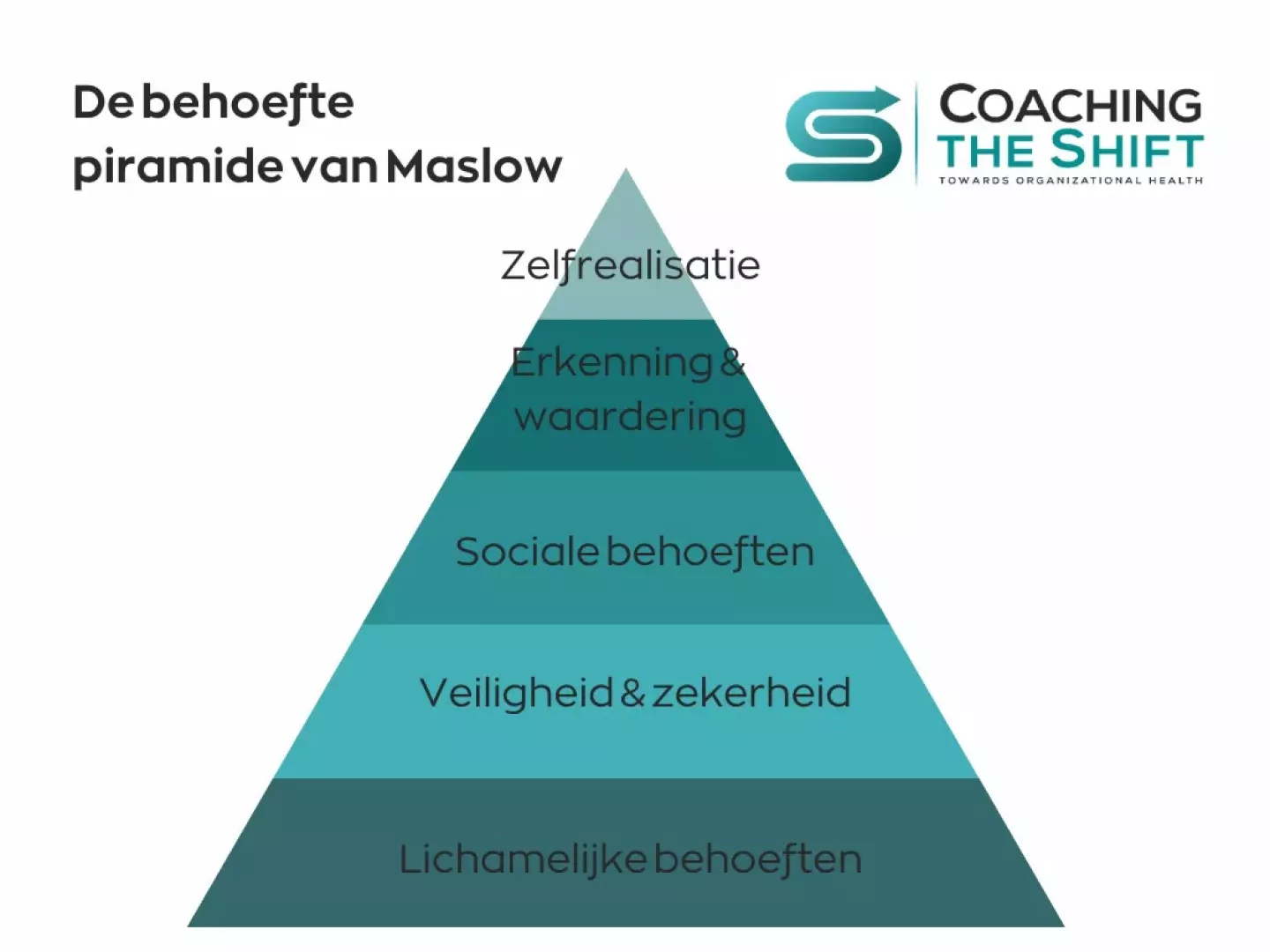
Personal leadership is about taking ownership of your own well-being — mentally, physically, emotionally, and spiritually. What are you already doing for your well-being? Do you take enough time to pause? Do you reflect on your own, or do you seek support through individual coaching?
Whichever step you choose, the first step is often the hardest — and therefore the most important step toward personal leadership.
What is personal leadership according to Stephen Covey?
Stephen Covey is the author of the bestseller The 7 Habits of Highly Effective People. According to his theory, you can only live an effective life when you are in balance. Many people live in conflict with their own values and goals. An essential part of self-development is therefore consciously creating a life that aligns with your beliefs and personal vision.
The three levels of dependence according to Stephen Covey
1. Dependence – personal development
In this stage, you are dependent on others. Life starts this way for everyone: as children, we depend on our parents. However, as we grow older, many people remain unconsciously dependent.
When your life depends too much on others, you have little influence over your own goals. This dependence can show up in many areas: mental, emotional, financial, physical, or otherwise.
2. Independence – self-mastery
Over time, we can grow toward independence. At this stage, you gain more control and influence over your own life. You have a clear sense of direction and have developed the skills needed to deal with challenges and setbacks.
However, independence is not the final destination. Independent people may be productive on their own, but that alone does not make them effective leaders or strong team players.
3. Interdependence – collaboration with others
At this level, you consciously rely on collaboration between individuals to achieve shared goals. You recognise that you can accomplish more together than alone. Interdependence is built on trust, cooperation, and the pursuit of win-win outcomes.
The 7 habits of highly effective people
In his book, Stephen Covey outlines seven core principles for living a more effective and meaningful life. These habits apply not only in the workplace, but also in your personal and social life. By taking ownership of your life, you create opportunities to grow, change, and live in a more balanced way.
These seven habits guide you on the path toward personal leadership:

Here is the English version of the 7 habits, aligned with Stephen Covey’s personal leadership framework:
The 7 habits of highly effective people
- Be proactive
Change starts with yourself. Focus on your circle of influence instead of wasting energy on things you cannot control. - Begin with a vision
A compelling goal is what drives us. What are you working toward in your life? What do you want to leave behind — professionally or personally? Having a vision is essential for self-development. Where do you want to go, and how will you get there? - Put first things first
Our energy is finite, so it’s important to use it wisely. When you focus first on small, non-urgent tasks, you often drain energy that would be better invested in important, high-impact work. - Think win-win
We are stronger together. By genuinely listening to the interests of others, you can work toward solutions that benefit everyone involved. - Seek first to understand, then to be understood
Most communication problems arise during listening. When we’re not fully present, we jump to conclusions or focus on being right. Listening with the intention to truly understand prevents this. - Synergise
Here, 1 + 1 = 3. By combining different perspectives in a win-win mindset, you often create better outcomes than you could achieve alone. The whole becomes stronger than the sum of its parts. - Sharpen the saw
According to Stephen Covey, personal leadership is only complete when you take good care of yourself. This means regularly resting and reflecting to keep the four dimensions of well-being — physical, mental, emotional, and spiritual — in balance.
If you’d like, I can also:
- Rewrite this in a more inspirational or marketing tone
- Adapt it for coaching, leadership training, or a workshop
- Turn it into a visual overview or exercise for clients

Veelgestelde vragen over persoonlijk leiderschap: een reis van zelfontplooiing
Inschrijven voor onze nieuwsbrief?
Other relevant articles


Obstakels als springplank voor ontwikkeling Mentale blokkades doorbreken in 5 stappen!