
Avoid these team dynamics:
The 7 pitfalls of team collaboration!
What are the pitfalls of collaboration in teams? A team is a web of personalities, interactions, and (often unspoken) thoughts. This can create complex dynamics that influence results—both positively and negatively. Here are 7 team dynamics you’re better off avoiding. Read more!
Marijke Van Moldergem

Team collaboration consists of a web of interactions, relationships, and behavioral expressions between different personalities—also known as team dynamics. The more personalities you add to the mix, the more complex these dynamics become. This can create both a positive and a negative butterfly effect throughout the organization.
When do team dynamics turn into pitfalls? Discover:
- What are team dynamics?
- A team as a system
- The 7 pitfalls of team collaboration
- #1 Groupthink and uniformity
- #2 Polarization and extremes
- #3 Lack of ownership
- #4 Unspoken disagreements
- #5 Conformity
- #6 Mismatch between process and system
- #7 Losing external connection
- How to make unproductive team dynamics visible
What are team dynamics?
We define team dynamics as follows:
“Team dynamics: the interplay of unconscious forces that arise from mutual interactions and collaboration within a team.”
This broad definition describes how individuals within a team interact with one another and how they work together as a whole toward a shared vision. You can see it as a complex web of relationships, interaction patterns, and behavioral expressions.
Each individual acts from their own frame of reference, shaped by values, personality, and past experiences. In teams, this can sometimes lead to friction—but also to powerful collaboration and, at times, even lifelong friendships.
Ultimately, team dynamics largely determine an organization’s culture. That’s why it’s essential to monitor and nurture them carefully. Team dynamics can be improved, for example, by cultivating a culture of trust and open dialogue.
A team is a system
One of the core principles of team coaching is approaching a team as a living system. Individuals together form something larger than themselves. This perspective is based on two key assumptions:
- The output of the system is always more than the sum of its parts
- There is interdependence: when one element moves, the entire system moves
That second point is what makes team dynamics so complex and unpredictable. Every action creates a reaction, which can lead to both positive and negative butterfly effects.
For example, if a colleague is having a bad day at home, it can affect the mood of the entire team. That, in turn, impacts results and influences the behavior of others. Teams are therefore in constant motion.
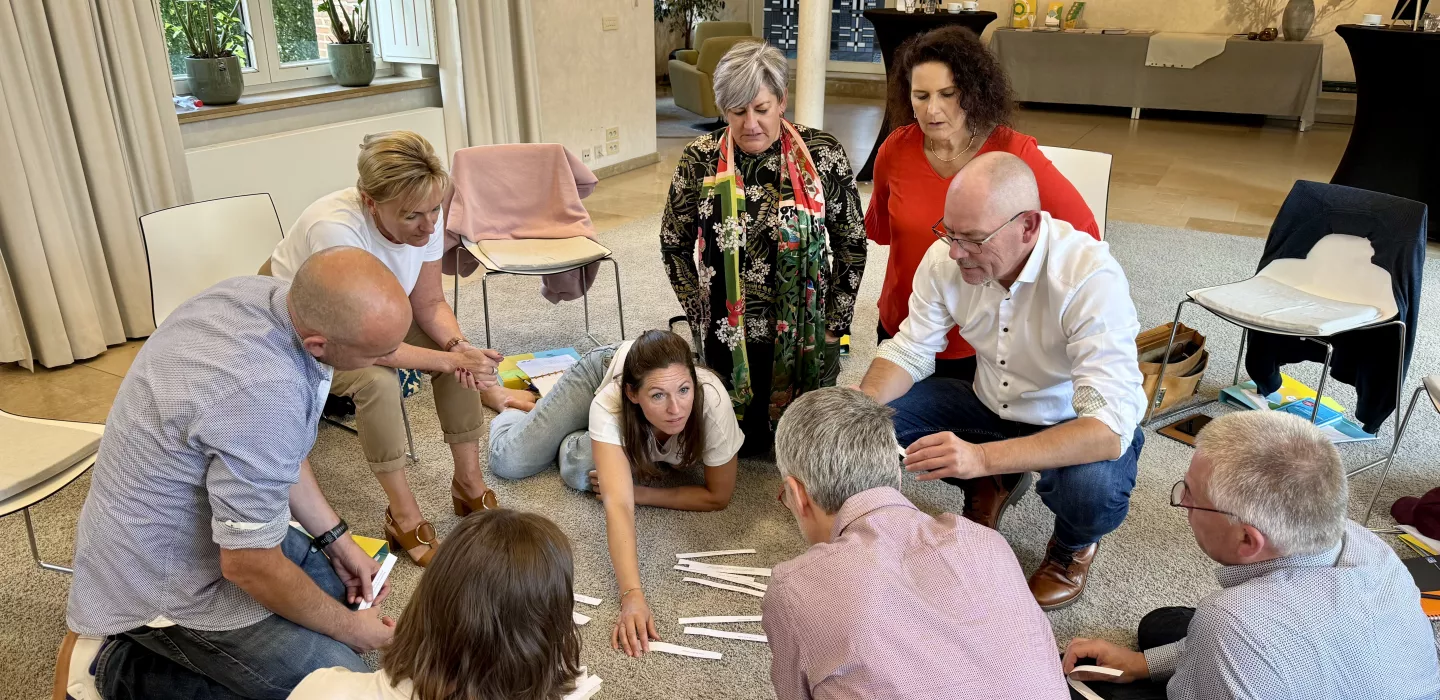
This can be illustrated beautifully with the following team coaching exercise. Each team member is asked, from the starting signal, to continuously form an equilateral triangle with two other people on the team. Very quickly, the entire team is set in motion—because when one person moves, everyone else has to move as well.
After trying different configurations, you’ll notice the same patterns repeating themselves. Eventually, the team comes to a standstill—through flexibility and compromise. At least for a moment. Until someone moves again and sets the whole team back in motion.
A powerful metaphor for what happens on the workplace floor every single day.

The 7 pitfalls of team collaboration
The beauty of working together as a team is that the whole can achieve more than the sum of its parts. In other words: 1 + 1 = 3. That’s not mathematics—it’s pure magic. But within that magic also lie several pitfalls.
Sometimes unproductive team dynamics emerge. This often happens unconsciously and unintentionally. People act from a positive intention, but fail to consider the impact on the system as a whole and on its results.
1) Groupthink and uniformity
Despite what many people believe, teams do not need to agree on everything. On the contrary. When they do, you’re likely lacking unique perspectives. The team loses its individuality and creative capacity.
Groupthink often arises from the intention to preserve harmony. People avoid discussion to maintain a pleasant atmosphere, but in doing so they lose sight of the bigger picture. Or the team consists of very similar personalities—the perfect recipe for uniformity.
2) Polarization and extremes
Groupthink can also lead to more extreme positions within the team—either overly conservative or overly progressive. What you might never dare to do alone suddenly feels acceptable as a group. The team feels strengthened as a whole and takes bigger risks. Or the opposite happens: the team becomes overly cautious, avoids all risk, and creativity and innovation are stifled.
3) Lack of ownership
Because teams often share responsibility, individual accountability can decrease. You’ll recognize this in statements like “someone else will handle it” or “that’s not my task.” Or the same team members keep carrying the same “shared responsibilities.” This quickly leads to frustration and is not sustainable.
4) Unspoken disagreements
Another common pitfall is that differences of opinion remain unspoken. They stay invisible or only surface too late, leading to frustration. Dominant personalities push their plans through, while the rest of the team executes them without true buy-in—wasting valuable perspectives that could have strengthened the outcome.
5) Conformity
Conformity is sometimes difficult to avoid, which makes awareness crucial. People naturally want to belong—that’s normal and healthy. But when unchecked, it becomes risky. Unspoken norms emerge, making it hard for new team members to integrate, especially when pressure to conform is high. This often leads to a loss of talent.
6) Mismatch between process and system
Sometimes there’s a mismatch between the team as a system and the processes they are expected to follow. Processes may be outdated, prompting teams or managers to bypass them. This leads to a loss of control and missed opportunities to improve the system itself.
7) Losing external connection
Finally, many teams fall into the trap of becoming too internally focused. A positive team atmosphere does not automatically lead to strong results. An echo chamber can form, where external feedback is perceived as criticism. Healthy collaboration requires staying connected to external stakeholders—such as customers, suppliers, or other teams.
How do you make unproductive team dynamics visible?
A team is only as strong as its weakest link—we all know the saying. But what exactly is that “weak link”? And how can you address it to improve collaboration in a sustainable way?

With this framework, you can make unproductive patterns visible and then actively work with them.
- Observe the other person’s behavior.
- What reaction does this trigger in you? What do you think and feel?
- How do you respond? What do you do?
- Step into the other person’s shoes. How might they be thinking about this?
- What reaction might this trigger in them?
By walking through these steps, you increase understanding and empathy toward the other person. This makes it easier to put things into perspective and break the vicious cycle.
Are you tired of falling back into the same patterns over and over again?
Other relevant articles


