Build High-Performing Teams – 8 Essential Skills of a Team Coach!
More than ever, the success of organizations is linked to the performance of teams. But how do you create an environment where high-performing teams can truly flourish? Discover the role of a team coach in optimizing collaboration, and explore 8 essential team coaching skills!

Marijke Van Moldergem

How do you create an environment where high-performing teams can flourish? As a team coach, you play an important role in uncovering hidden team dynamics and unproductive patterns. You facilitate open communication and thereby improve collaboration. Which skills does a team coach need to take teams to the next level?
Discover the 8 crucial skills of a team coach here!
- The role of a team coach
- 8 essential team coaching skills
- Your continuous development as a team coach
The Role of a Team Coach
A team coach helps build a healthy and productive team culture, among other things by facilitating open communication and stimulating collaboration and results-oriented work. The role of a team coach varies depending on the situation. Organizations, for example, often work with both internal and external team coaches. Although both share certain core coaching skills, their focus, style, and approach can differ significantly.
An external team coach, for instance, is often brought in to facilitate peer consultations, mediate team conflicts, or guide teams and managers through transformation and development processes. External coaches can objectively identify and address patterns and challenges within the team.
In contrast, an internal team coach focuses more on supporting internal initiatives and development processes. An internal team coach often helps improve communication and build a safe environment where open dialogue is possible. Because they are familiar with the organization’s culture, ways of working, and the challenges the team faces, they can better align collaboration with the collective goals and the needs of the team.
8 Essential Team Coaching Skills
But which skills make a great team coach? As a team coach, you play a crucial role in guiding and developing teams. To work effectively, it is important to master these 8 team coaching skills!
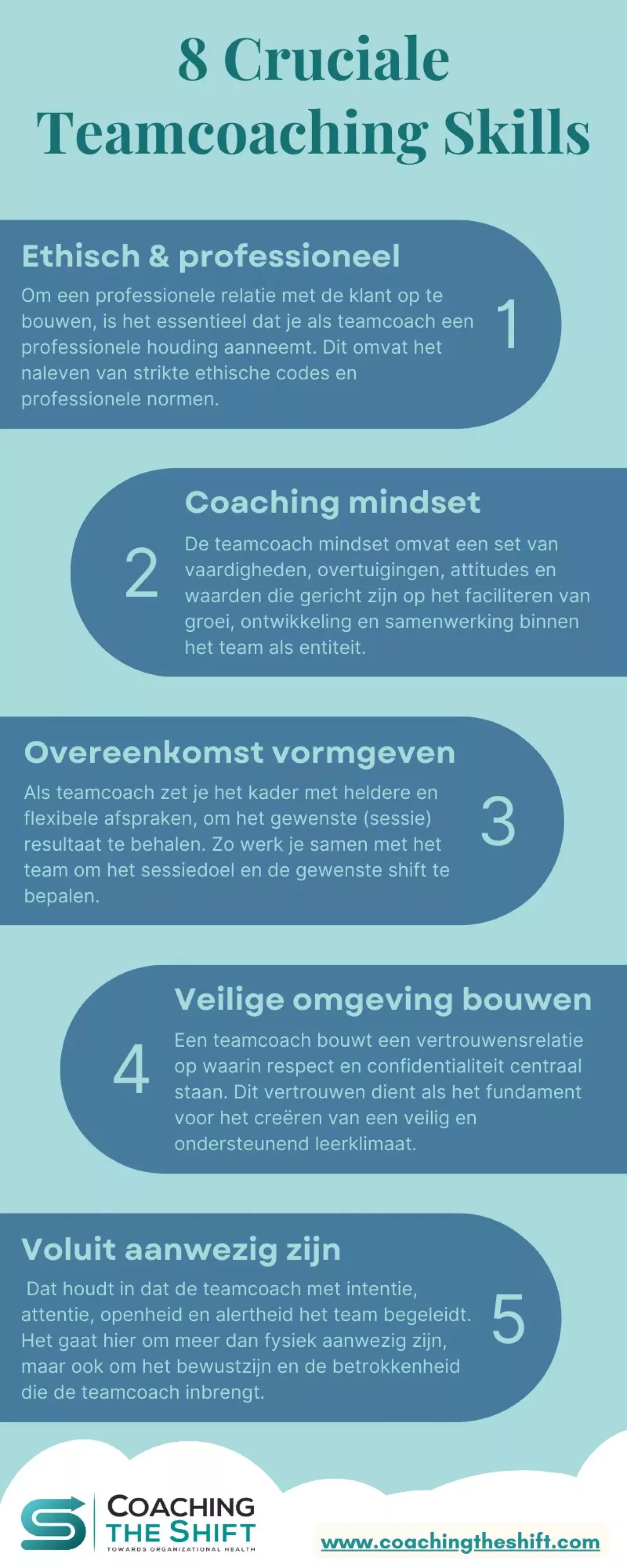
8 Essential Team Coaching Skills
1) Acting Ethically & Professionally
To build a professional relationship with the client, it is essential that you, as a team coach, adopt a professional attitude. This includes adhering to strict ethical codes and professional standards.
You clearly define the boundaries of team coaching. This means communicating the distinction between team coaching, consulting, training, and team building. By doing so, you create clarity around roles, responsibilities, and expectations for all stakeholders. In this way, you work in harmony with both the team leader and the team as one entity.
2) Coaching the Team from a ‘Coaching Mindset’
A team coaching mindset forms the foundation for creating a safe environment in which teams can realize their full potential. This mindset includes a set of skills, beliefs, attitudes, and values focused on facilitating growth, development, and collaboration within the team.
Everything starts with recognizing and appreciating the unique talents, insights, and actions within the team. You see the team as a whole and are able to listen and support without judgment, approaching the team with an open mind and multiple perspectives.
You also give the team ownership over the content of the sessions and actively search for deeper insights beyond the obvious. You continuously adapt your style to the context and involve the entire team in the journey toward better collaboration.
3) Designing the Team Coaching Agreement
Every successful collaboration begins with clear agreements. As a team coach, you create a framework with clear yet flexible agreements to achieve the desired session outcomes. For example, you work together with the team to define the session goal and the desired shift.
In co-partnership with the team leader, you map out the team’s drivers and motivators. You then determine how ownership is shared between the team, the team leader, and the team coach.
It is important to remain flexible and respond to feedback and results emerging within the team, as the coaching process may bring new insights, challenges, or changes.
4) Building a Safe Environment Based on Mutual Respect and Trust
A team coach builds a relationship of trust in which respect and confidentiality are central. This trust forms the foundation for creating a safe and supportive learning environment.
The team coach acknowledges and values the unique talents, insights, and actions of the team. There is space to listen to concerns, feelings, and perceptions. By listening with empathy rather than judgment, you create an environment where team members feel safe to express themselves and are supported in their ideas and initiatives.
5) Mastering the Art of ‘Full Presence’
One of the most important skills of a team coach is the ability to be fully present. This means guiding the team with intention, attention, openness, and alertness. It goes beyond physical presence — it involves the awareness and engagement the coach brings into the process.
As a team coach, you see each team member in their entirety and view the team as a single entity. You observe what happens in the here and now, using your senses — seeing, hearing, and feeling — to gain insight into team dynamics and patterns. You are also able to shift perspectives and view situations through different lenses to deepen understanding.
Finally, you remain aware of yourself and the impact of your actions and intentions on the team. You allow the team to determine what needs to happen during sessions. By focusing on facilitation and process rather than content, you become comfortable with not always knowing the right answer. You dare to experiment and trust your intuition, thereby encouraging ownership and responsibility within the team.
6) Team Coaching Starts with Active Listening
Active listening is one of the core skills of a team coach. By listening actively, you create an environment where team members feel heard and understood while also picking up signals that might otherwise remain hidden.
You adapt your questions and observations based on the team and the situation. To understand what is happening within the team, you explore and inquire about the emotions and concerns experienced by both individuals and the team as a whole. You provide space for uninterrupted expression and remain attentive to non-verbal signals, energy shifts, and observable behaviors.
Finally, you summarize insights and reconnect them to the team’s priorities and objectives.
7) Expanding Awareness
A team coach expands awareness by exploring, reflecting, and questioning beyond surface-level observations. By encouraging open dialogue and inviting the team to explore different perspectives, you improve team dynamics and collaboration.
You listen to the team’s thinking, feeling, and actions regarding values, norms, desires, and beliefs. Your questions go beyond the obvious, challenging perceptions to broaden awareness and outcomes.
You share observations, intuitions, reflections, hypotheses, and feelings without attachment and invite the team to explore them together. You stimulate a circular exchange of perspectives and encourage the team to address — especially — difficult or unspoken topics.
8) Facilitating the Client’s Growth Process
A team coach facilitates team growth by encouraging reflection, awareness, and action-oriented learning. You invite team members to explore the progress made toward their goals and ask what insights they have gained about themselves, the team, and the situation.
You identify and name inconsistencies and patterns within current team dynamics. By highlighting parallel processes, underlying behaviors and dynamics become visible, helping the team understand habits or automatic reactions that maintain the status quo.
Finally, you help the team anticipate potential obstacles, identify available resources, and clarify how team members will take ownership of follow-up actions. You also acknowledge and reinforce progress already made to maintain motivation and engagement, contributing to sustainable team development.
Develop the 8 fundamental team coaching skills in our MasterClass Team Coaching program!
Your Continuous Development as a Team Coach
Once you have mastered the eight crucial skills, your development journey as a team coach truly begins. Coaching is a dynamic profession that continuously evolves. Therefore, it is essential to keep developing yourself and stay informed about new insights, methods, and approaches.
Prefer not to take this journey alone? Discover our Shift & Grow community or contact us for a team coach mentorship program tailored to your needs!
Veelgestelde vragen over Teamcoach vaardigheden als groeiversneller
Inschrijven voor onze nieuwsbrief?
Other relevant articles