Role of the Team Coach | Getting Started with Team Coaching
What is the role and focus of a team coach? As a team coach, there are many aspects you can direct your attention to. Marijke Lingsma provides structure in her book Aan de slag met teamcoaching. We further expanded on this team coaching model. How can you use yourself as an observation tool by being attentively present, without assumptions?
Magaly De Smet

What is the role and focus of a team coach? As a team coach, there are many aspects you can direct your attention to. Marijke Lingsma provides structure in her book Aan de slag met teamcoaching. We further expanded on this team coaching model. How can you use yourself as an observation tool by being attentively present and free from assumptions?
Discover it in this article:
- Being present in the here and now
- Recognizing and naming patterns
- The parallel process
Being present in the here and now
The focus of a team coach lies primarily in the here and now and the future. Only in exceptional cases do we look back at the past—for example, for forgiveness exercises or unresolved conflicts. However, we create far more value by focusing on what is happening right now and how we can change this to achieve the desired future.
By reflecting what unfolds in the here and now, you accelerate awareness within teams. Teams are often unaware of their own behavior—and even more so of the impact this behavior has on others. Behind this behavior, there is usually a positive intention. It is the role of the team coach to uncover this intention and explore it further.
Recognizing and naming patterns
Once you know where to focus as a team coach, you can use your awareness to recognize patterns. But when do we actually speak of a pattern? A pattern is a repetition of behavior, often as a reaction to a particular emotion or way of thinking. In general, the rule of three is a good guideline. If something happens once, it usually means nothing. If it occurs a second time, it may be a coincidence. Only when you notice something for the third time can you say with near certainty that a pattern is present.
Recognizing a pattern does not mean you should immediately share it. You run the risk that the group is not yet aware of the pattern and may even turn against you as a form of self-protection. What you can do instead is invite the group to share their own observations. Often, they will express similar insights that confirm your initial impression.
If the intensity becomes too high—for example, when someone starts shouting—you can step in with your observations. This, too, is part of the role of a team coach. For example:
“When things become tense, you switch to operational topics. How recognizable is this for you? What would it be like to go deeper into this?”
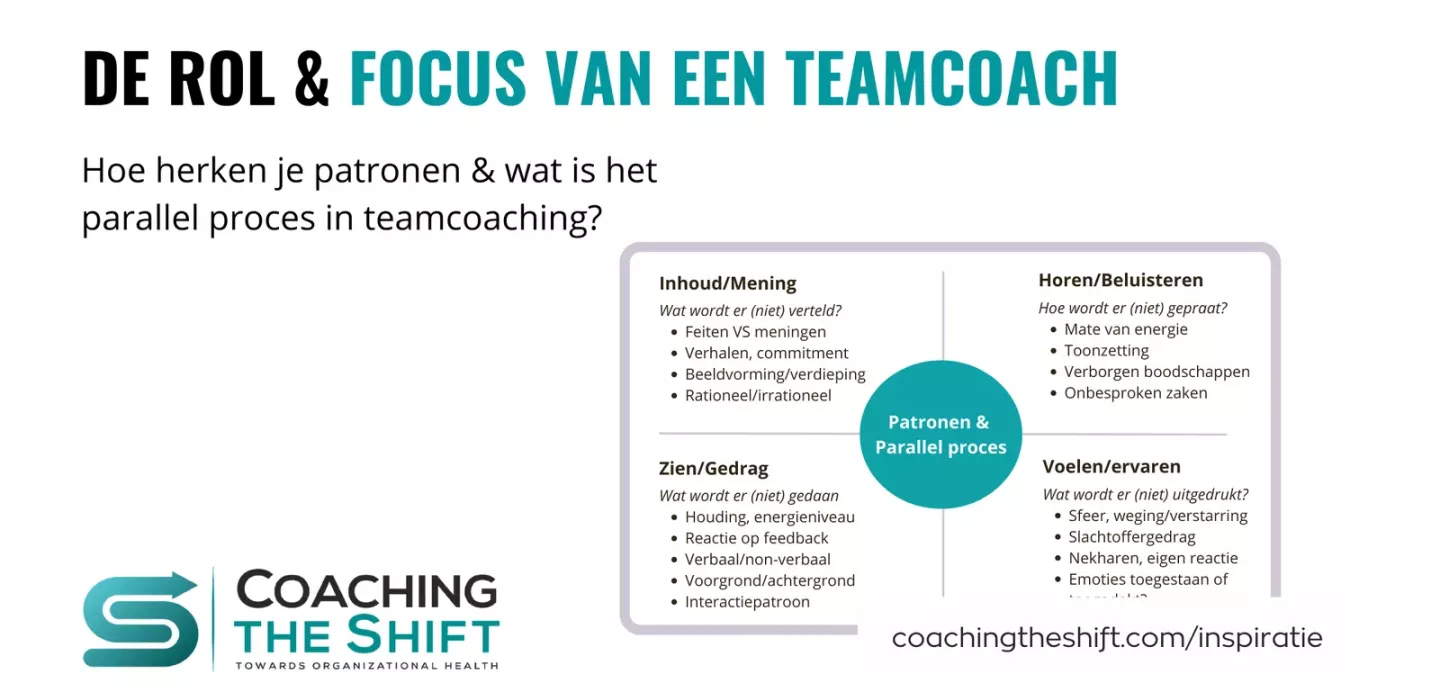
Marijke Lingsma developed a model to recognize patterns in her book Aan de slag met teamcoaching. We further expanded this model based on our own experience and expertise.

Discover more models like this on our free coaching tools page!
1) Content / Opinion
What is (not) being said?
Content is concrete and verbal. You observe what is or is not being said and form an unbiased picture of it. This means you do not yet interpret what is being said—you simply register it.
- Which beliefs are at play?
- Facts versus opinions
- Do stories align with one another or not?
- Is there meaning-making and depth?
- Are thoughts rational or irrational?
- What is not being discussed or is being avoided?
2) Hearing / Listening
How is (not) being spoken?
Listening is verbal, but often a subtler way of observing. People frequently show unconscious signals in their tone, energy, etc. This is therefore not necessarily about what is said, but how it is said. This allows you to detect hidden communication and bring your hypotheses to the table later.
- Direct or indirect? Are people cautious?
- Level of energy: a lot or little talking?
- Tone: accusatory, complaining, positive, …
- Hidden messages in communication
- How is not being spoken?
3) Seeing / Behavior
What is (not) being done?
Behavior is concrete again, but non-verbal. By registering how the group behaves, you can sometimes infer certain dynamics. For example, do the same people make eye contact—or roll their eyes—when someone speaks? Then you can explore why. Do certain people stay in the background? Try to bring their perspective forward, etc.
- How are group members positioned?
- What stands out in posture?
- How does the group respond to feedback?
- What reactions do you get—both verbal and non-verbal?
- What am I missing? What do I not see?
- Which behavior determines who stays in the foreground or background?
- Energy: who is working the hardest?
- Who carries the problem—and how do you see that?
- What is the interaction pattern?
4) Feeling / Experiencing
What is (not) being felt or expressed?
Finally, there is the emotional dimension—non-verbal and more abstract. Still, it can be helpful as a team coach to follow your intuition. You can observe how the team deals with emotions and how this impacts your own emotions as well.
- How does the team deal with emotions and feelings?
- Who steps into the victim or accuser role?
- What is the overall atmosphere?
- Is there consideration for others’ emotions?
- What automatic responses appear with criticism: fight, flight, freeze, …?
- What is your own reaction to the story?
- Are emotions allowed, avoided, or covered up?
- What do you feel? What makes the hair on the back of your neck stand up?
Ready to get started with team coaching yourself? Take your team to the next level with the Team Coaching Masterclass!
The parallel process
The parallel process in team coaching refers to the similarity between what unfolds in the here and now and what happens there and then. In short, patterns that show up in a team coaching setting often also occur on the work floor. The role of the team coach is to identify these patterns within the parallel process.
By remaining neutral as a coach and not influencing the situation, these patterns reveal themselves before your eyes. Naming them in the moment creates an opportunity for increased awareness and exploration. You can then dive deeper into the underlying causes and the effects of these patterns on both the group and individuals within the team.
For example:
“With every new idea that is introduced, someone in the group immediately has a counterargument ready. I wonder whether this is a coincidence or if it also happens on the work floor? Who recognizes this mechanism?”
Attention! Always present such statements as hypotheses. This gives the team space to reflect their own perspective without feeling personally attacked or criticized.
Join 1000+ coaches, leaders, and entrepreneurs—and help build your high-performing team!
Veelgestelde vragen over
de rol & focus van een teamcoach
Other relevant articles