The art of setting frameworks
From chaotic meetings to productive discussions
Unnecessary and unproductive meetings are a common problem in organizations. But with the art of “setting frameworks,” you can change this. In this article, we explain how clear boundaries and expectations lead to more effective meetings and greater engagement. Discover how, as a leader or coach, you can provide structure to transform chaotic gatherings into productive sessions that deliver results!
Silvia Zeppieri

What is framework setting and why is it important? No one enjoys unnecessary or unproductive meetings. Yet they occur frequently in organizations, often causing frustration among participants. While communication should certainly be encouraged, it is equally important to start every meeting with a clear purpose and expectations. This is what makes the difference between a chaotic gathering and a productive meeting.
In this article, we take a deep dive into the art of framework setting:
- What is framework setting and why is it important?
- Setting boundaries and managing expectations
- How do you maintain a safe framework during team meetings?
- The difference between framework setting as a leader and as a coach
- Framework setting: the end of unproductive meetings
What is framework setting and why is it important?
Every leader recognizes this situation: you organize a team meeting with the best intentions, but it quickly becomes clear that things are not going as planned. Either participants are distracted and barely engage, or there is so much feedback that discussions spiral out of control and concrete results fail to emerge. Providing structure and setting clear goals is essential for effective meetings.
This is where framework setting comes in. Framework setting is a technique used by coaches to provide structure in conversations by defining clear boundaries, roles, and expectations from the very beginning. This ensures everyone understands why they are present and what is expected of them.
A shared framework not only creates clarity but also fosters a safe environment. Team members make shared agreements and carry collective responsibility for them. Framework setting also allows teams to pause and ground themselves. Most people are busy with their jobs, ongoing projects, and personal matters, so they need time to become fully present during a meeting.
Setting boundaries and managing expectations
Framework setting starts with establishing shared boundaries. This may sound restrictive, but the opposite is true. Healthy boundaries create a safe environment in which team members can speak freely without fear or uncertainty.
But what does framework setting involve in practice, and which frameworks help create an effective environment?
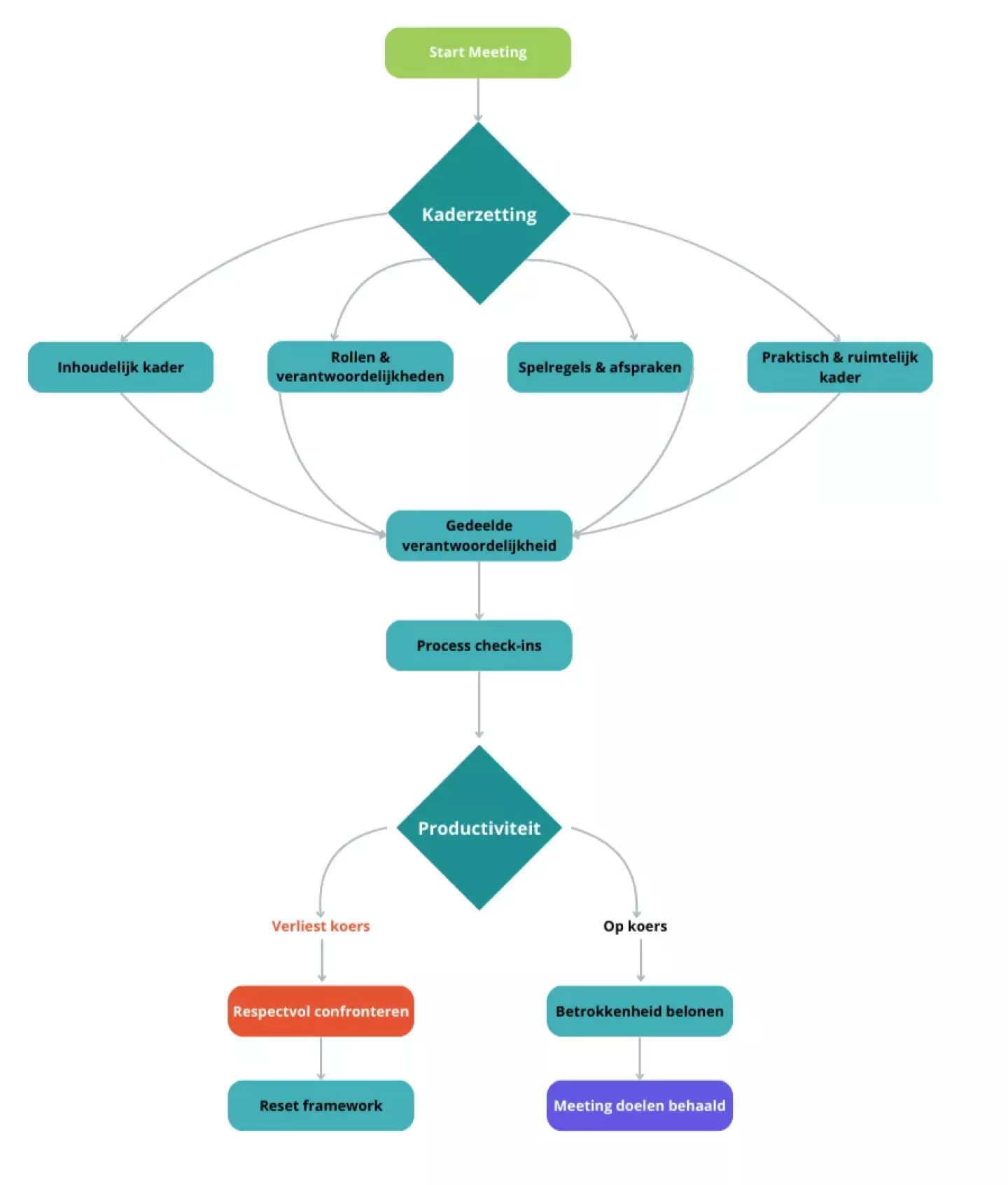
- Content framework: What do we want to achieve with this meeting or project? Clear goals ensure everyone is aligned and include defining strategies to reach those goals.
- Roles and expectations: Who does what? This clarifies responsibilities and prevents misunderstandings while improving efficiency.
- Mutual agreements and boundaries: Respectful communication is key to open dialogue. Agreements such as allowing people to finish speaking help ensure everyone feels heard.
- Practical agreements: For example, agreements about phone use or breaks. These seemingly small details can significantly impact focus and productivity.
- Exceptions: Everyone has unique needs, so frameworks should be discussed with the team rather than imposed unilaterally. Exceptions may include work obligations, medical reasons, and other circumstances.
In short, involve team members by inviting them to share expectations beforehand. This prevents chaos or disappointment later and creates a strong foundation for successful collaboration.
How do you maintain a safe framework during team meetings?
Once a clear framework is agreed upon, it is important to maintain it. For example, if someone interrupts another speaker, you can respectfully mirror this behavior to raise awareness of the agreed framework and goals. This responsibility does not belong only to the leader but to the entire team.
Make explicit agreements together about safeguarding the rules for productive meetings. You might agree on a signal (a word or gesture) that alerts participants when meeting agreements are at risk of being broken — whether someone is speaking too long or ignoring feedback guidelines.
Practical tools include check-ins or reflective questions such as:
- Are we still on track? Does this still relate to the topic?
- What is the next step? How do we turn this into action?
- What shared responsibility do we have here?
Respectful confrontation means drawing attention to something without judgment. In productive meetings, there is no space for personal attacks or criticism. The starting point is always positive intent, avoiding unnecessary discussions or conflicts.
The difference between framework setting as a leader and as a coach
Although the roles of leader and coach often overlap, there is an important difference in how they set frameworks. Coaches typically provide a neutral framework, while leaders have more influence over how the framework is designed.
Coaches often work in a three-way collaboration involving both leadership and the team. Their role is to ensure that the goals of all parties are represented, requiring an objective approach in which everyone is heard. This neutrality supports open communication and collaboration.
Leaders, on the other hand, play a more active role in shaping the framework. This can be challenging because building trust becomes more complex when different frameworks are used — for example, during brainstorming sessions, planning meetings, or evaluation conversations.
“Permissions are often still strongly linked to positions. When leaders explicitly state that everyone may contribute or stop a discussion, interaction becomes much more dynamic.”
Leaders can also use their influence to mobilize teams and stimulate shared responsibility. By explicitly granting permissions — and modeling the desired behavior themselves — teams tend to follow much more quickly.
Framework setting: the end of unproductive meetings
Framework setting is the key to ending endless and unproductive meetings. It provides structure and clarity, enabling teams to collaborate more effectively. By defining clear goals, boundaries, roles, and expectations from the start, you create an environment in which everyone knows what is expected of them.
Leaders can strategically use framework setting to stimulate shared responsibility within their teams. By giving explicit permissions and acting as role models, team members will feel more engaged in the process. This not only improves collaboration but also increases productivity during meetings.
In short, by consciously paying attention to framework setting, you can transform chaotic meetings into inspiring sessions that lead to concrete results. It is a powerful tool that helps leaders guide their teams toward success, with respectful communication and shared responsibility as the foundation.

Ready to take your team to the next level? Discover the Kickstart Team Coaching for Leaders!
Other relevant articles