How do you overcome drama at work?
From the drama triangle to the winner’s triangle!
Do you sometimes leave a meeting with a bitter feeling? Do you ever think, “I should have said this,” or “I should have responded differently”? In this article, we explore Karpman’s Drama Triangle — a coaching model that helps you recognize unconscious behavior and transform it into positive actions!
Christine Esteingeldoir

The Drama Triangle is a powerful model for team development. In our team coaching program, we use this coaching model to make unproductive role patterns recognizable, visible, and discussable. This allows you to identify different roles in time and intervene in a constructive and caring way.
Do you sometimes leave a meeting with a bitter feeling? Do you ever think, “I should have said this,” or “I should have reacted differently”? Working with people means dealing with emotions — both your own and those of others. Sometimes things go wrong. When emotions or fears take over, you may end up in what we call a Drama Triangle.
Are you tired of workplace drama? Then this article is for you! We’ll cover:
- What is the Drama Triangle?
- 3 causes of the Drama Triangle
- From the Drama Triangle to the Winner’s Triangle
- The Drama Triangle in practice for team development
What is the Drama Triangle?
The Drama Triangle is a classic example of communication that goes wrong. In our team coaching program, we use the model to make behavioral patterns recognizable, visible, and discussable — because they are familiar to everyone.
Within these behavior patterns, individuals avoid taking responsibility for their own behavior or their role in the situation. As a result, there is little room for team development. Communication becomes indirect and filled with hidden messages, often accompanied by a lack of mutual respect.
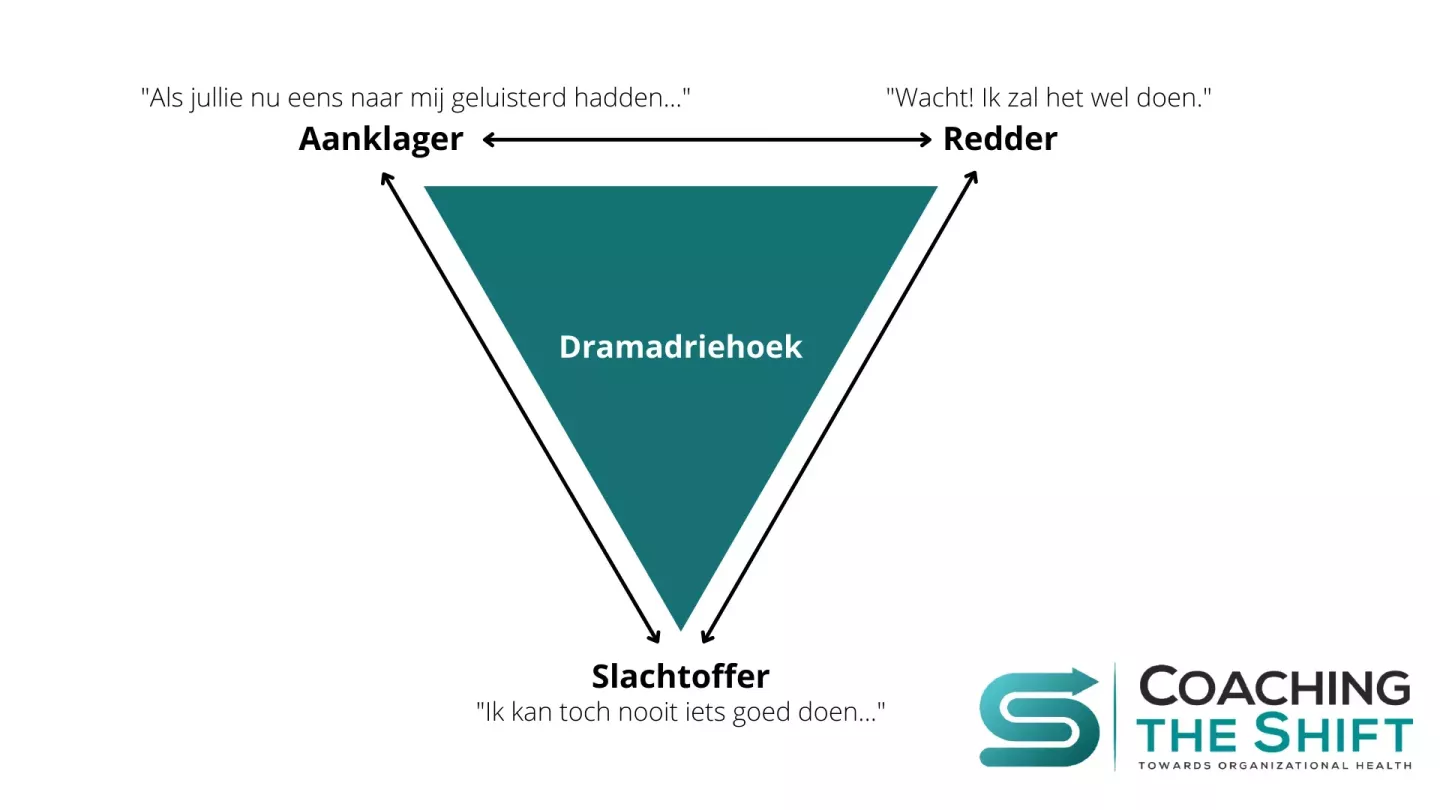
In general, there are three roles within the Drama Triangle. These roles are interchangeable. For example, if the rescuer does not feel sufficiently appreciated, they may shift into the victim role. In other words, behavior triggers behavior. When one team member slips into a drama role, others are likely to follow.
Regardless of the role you take on, everyone leaves the conversation with a bitter feeling. These types of patterns occur in both professional and personal relationships. The more these situations repeat themselves, the more energy they drain from everyone involved. In a Drama Triangle, everyone loses.
The 3 drama roles
As a professional coach, it is important to be able to overcome these situations through powerful communication. In our team coaching program, we explore the drama roles in depth and learn how to recognize, stop, and raise awareness about them.
This coaching model goes beyond repeated behavior patterns — it also brings a great deal of metacommunication to the surface.
Persecutor
The persecutor says things like, “You’re useless to me,” or “If you don’t do what I say, it will never work.” This role often positions itself above the rest of the team. When mistakes happen, the persecutor quickly shifts responsibility to the victim or the rescuer.
The persecutor gives negative feedback or criticism that is often directed at the person rather than the work. They blame others for mistakes and avoid taking responsibility themselves. This creates a culture of fear and is harmful to team development.
A persecutor is often strongly convinced of their own vision and may become aggressive when others do not understand it. The core issue is a lack of constructive feedback and clear communication. Persecutors tend to underestimate others’ abilities while overestimating their own.
Rescuer
The rescuer solves other people’s problems without being asked. They see others as needing help and often do more than necessary.
“Wait, I’ll fix it!” A rescuer takes away others’ responsibilities and makes them dependent. In Karpman’s Transactional Analysis, this relates to the rescuer’s ego needs — often seeking recognition and wanting to feel needed.
Rescuers frequently create dependency within the team. When something becomes difficult, they take over, preventing learning and growth for the person being helped. Even though rescuers usually act with good intentions, they unintentionally maintain negative patterns and hinder progress. They also often fail to take the persecutor seriously.
Victim
The victim feels unable, unwilling, or afraid to take action. This role lacks belief in their own ability to solve problems and therefore places blame on others when things go wrong.
Typical statements include: “There’s nothing I can do about it,” or “I never do anything right.” The victim presents themselves as helpless and often feels powerless. They become irritated with the persecutor and seek sympathy from the rescuer.
Victims tend to put themselves down, take criticism very personally, and respond passively to situations.
Do you want to take control of drama situations? Discover our team coaching program and boost your team development!
3 causes of the Drama Triangle
#1 Unequal relationships
In a Drama Triangle, relationships are often unequal. People take either a superior or inferior position. These power imbalances create fear around open dialogue. As a result, hidden agendas emerge and mutual respect often diminishes.
When this escalates, it can lead to a gossip culture. This only increases distrust and shifts the focus toward negative aspects of the relationship. Once attention is fixed on what is going wrong, it becomes much harder to recognize positive elements.
#2 Not recognizing your own role
In the Drama Triangle, no one takes responsibility for their own behavior. Because individuals fail to acknowledge their contribution, frustration continues to build between people. For example, a rescuer may not realize they are maintaining the victim role.
Behavior often originates from deeper emotions such as fear or insecurity. A team leader, for instance, may give harsh feedback due to stress about presenting to senior management. Team members, in turn, may blame the leader for insufficient briefing or preparation time.
In reality, both sides may be partly right. The key is recognizing your own role and admitting that you, too, make mistakes.
Giving feedback is an art. We often underestimate the impact our feedback has on the receiver. In our team coaching program, you learn different methods to give feedback with care and respect for others.
#3 Blaming others
A defining characteristic of this coaching model is not only avoiding responsibility but also placing blame on others. People project their frustrations outward because they are unwilling or unable to confront their own mistakes.
Eventually, attention focuses solely on what others are doing wrong, leaving little space to work on the relationship — or on personal growth. If you are overly focused on someone else’s mistakes, it may be a sign that personal reflection is needed.
From the Drama Triangle to the Winner’s Triangle
So how do you break the vicious cycle of drama? The first step toward change is awareness. In a strong team coaching program, you learn how to help team members recognize drama roles and guide them toward ownership and collaboration.
Next comes taking — or allowing — responsibility. Understand when responsibility belongs to you and respect when it belongs to someone else.
Finally, communication is essential. To fully break the Drama Triangle, everyone must step out of their role. How do you pause such situations? How do you respectfully make someone aware of their role? And how can these insights be used for team development? These are coaching competencies you learn in our team coaching program.

Winner roles
Assertive communicator
An assertive communicator is the opposite of the persecutor. This role provides constructive feedback and can express thoughts, opinions, and feelings assertively and respectfully, with team development as the primary goal. Assertive individuals clearly articulate what they need and are able to say no when necessary.
At the same time, assertive communicators are open to change and willing to receive and implement feedback themselves. They often frame feedback using statements such as “I think,” “I want,” or “I feel,” while respecting others’ perspectives. They set clear boundaries and communicate openly and honestly.
Helper
Unlike the rescuer, the helper supports others in growing. They allow people to do their own work unless help is explicitly requested. When helpers offer support, they do so in an empowering and supportive way.
Helpers do not think for others — they help others think for themselves. They create space for learning and making mistakes and trust in others’ abilities to find their own solutions.
Realist
A realist views what they cannot yet do as an opportunity to learn. This role is aware of personal emotions and takes them seriously. Realists can clearly communicate boundaries and ask for help when they cannot solve a problem alone.
A realist must be willing to show vulnerability. They are not afraid to test their own abilities — or acknowledge their limitations.
The Drama Triangle in practice for team development
Do you recognize these situations from your own life? Do you sometimes fall into one of these roles? Would you like to break these patterns once and for all? Using the Drama Triangle as a coaching model requires insight and coaching experience.
Not only must you recognize roles through the (often hidden) communication within teams, but you must also communicate effectively enough to help people become aware of their roles. In our team coaching program, you gain insight into unconscious thinking patterns and learn techniques such as powerful questioning and constructive confrontation to stimulate awareness and growth.
Would you like to guide teams from drama to winning dynamics? Discover our team coaching program!
Veelgestelde vragen over: Hoe overwin je drama op het werk? Van drama-naar winnaarsdriehoek!
Inschrijven voor onze nieuwbrief?
Other relevant articles