Behind the scenes:
What you learn in the Masterclass Team Coaching
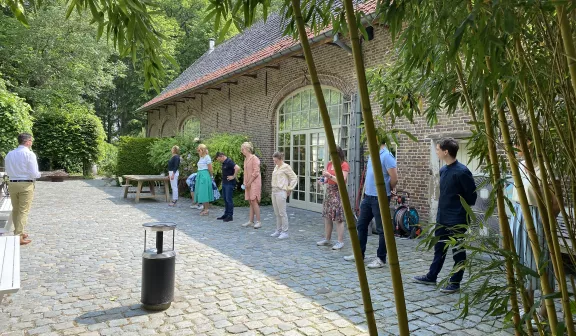
Recently, we had the opportunity to deliver the Masterclass Team Coaching to a mixed group of in-company professionals. The diversity within the group once again led to many interesting insights. Unfortunately, all good things must come to an end—and so did this program. Although it feels like the final song has not yet been fully played!
We asked the participants what they are taking away from the training and how they view their future as team coaches. Curious about their answers? Read more in the article!

Magaly De Smet

Recently, we had the opportunity to deliver the Masterclass Team Coaching to a mixed group of in-company professionals. The diversity of the group once again led to many interesting insights. Unfortunately, all good things must come to an end—and so did this program. Although we have the feeling that the song is not yet fully played for this group. We asked the participants what they took away from the training and how they look at the future as team coaches.
Curious about their answers? Discover more:
- The challenges of teams today
- What you learn in the Masterclass Team Coaching
- More than a training program: Moments that stay with you
- Why you should also follow the Masterclass Team Coaching!
The challenges of teams today
People are the greatest source of value in an organization. But a growing number of personalities often also leads to increasing complexity in team dynamics. This frequently brings a number of challenges.
1) Effective communication and collaboration
Most communication breaks down at the level of interpretation. Because we don’t always say what we really mean. And because the positive intention behind our behavior often remains hidden. But what is the difference between reality and perception? And how do you create a shared reality as a team?
2) Team development and engagement
High-performing teams are constantly in motion. New people join the team, others leave (temporarily) or change roles—which creates many challenges in building a cohesive team. But what does a team need in each phase? And how can you, as a team coach, support this process?
3) Conflict management and skills
In any collaboration, conflict will arise sooner or later. That doesn’t have to be a bad thing. Different perspectives often bring out the best in all parties. But what if a conflict is not handled well? Then it can quickly escalate, with all the consequences that come with it.
4) Dealing with change
To keep up with today’s world, teams need to be able to handle continuous change. Think, for example, of a new software system or a new way of working. As well as a new purpose, role, or team composition. How do we let go of the old, and what makes us more adaptable and resilient as a team?
5) Stimulating reflection & continuous development
The holy grail of every organization: people who take ownership of their own development. Diversity in teams is so powerful because it is complementary. When teams reflect together on what can be improved and how they can support one another, you unlock the hidden superpower of the group!
In the Masterclass Team Coaching, you learn how to deal with these challenges from the role of “team coach.” You help uncover invisible patterns and make the unspoken discussable. This allows teams not only to work more effectively, but also to show up with greater motivation and engagement.
What you learn in the Masterclass Team Coaching
In the Masterclass Team Coaching, you gain various insights into team dynamics. This starts with defining your role as a team coach. A real eye-opener here is that you, as a team coach, do not need to provide solutions yourself. The power of a team already lies within the group!

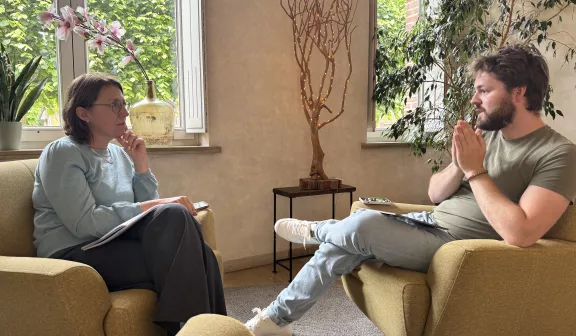
As a team coach, you also develop essential skills such as curiosity, neutrality, active listening, and circular questioning to surface (hidden) insights within the group. In addition, you are given a wide range of practical tools that facilitate the coaching process and foster deeper understanding—both for you as a coach and for the coachees.
Some of the models we cover in this program:
- The 5C model by Peter Hawkins
- The 4 team roles by David Kantor
- Thomas–Kilmann conflict styles by Kenneth Thomas and Ralph Kilmann
- The Lencioni Pyramid by Patrick Lencioni
- The team development model by Bruce Tuckman
- Multiple intervision methods
- The speed of trust by Stephen M. R. Covey
- A wide range of intervention techniques such as the Walking Scale, Iceberg method, …
…And so much more!

Ultimately, you mainly learn to slow down: taking time for—and giving time to—the process. This often moves you forward faster than you might expect and brings more calm along the way. A team coach’s primary role is to facilitate the process and reflect the patterns they observe. This doesn’t have to be perfect. What needs to surface will eventually rise to the surface.
“You can do more than you think! This realization also felt like a win for myself—namely, greater self-confidence as a coach.”
Finally, you also get to know yourself better. Who do you want to be as a team coach? And how do you use yourself as a tool? For example, by naming your internal dialogue. This starts with building trust—both in yourself and in the team you coach. Dare to be vulnerable yourself. It’s remarkable how quickly a team opens up when you give them the space to do so safely.
More than a training program: Moments that stay with you
When you take part in the Masterclass Team Coaching, you quickly notice that it is not an ordinary training program. It goes far beyond dry theory. For example, the very first day for this group started with a LEGO Serious Play session. What better way to introduce people to one another—and to the world of team coaching—than playfully working together with LEGO?

After this kick-off, the tone was immediately set and consistently carried through. Each training day begins with a check-in facilitated by one of the participants. Afterwards, the group shares feedback in a constructive way. It is inspiring to see how quickly the group opens up and learns from one another. This leads to very genuine—and sometimes even moving—moments.
Because real-life cases are used throughout the program, you go home after each session with new insights and practices to apply. Even between sessions, you remain continuously engaged with team coaching. You stay involved through “homejoy” assignments and small techniques. We also often work with books. And when you have an engaged group like this one, you continue to challenge and enrich one another—also after the training program!
Why you should also follow the Masterclass Team Coaching!
What is great about the Masterclass Team Coaching is that you learn from true experts in the field. Everything you see or experience is therefore immediately a lesson in the world of team coaching. The trainers respond seamlessly to the needs of the group. Do you have a challenging question? Then the schedule can easily be adjusted! In addition, they openly share their own experiences and mistakes, which is an enormous added value for every starting (team) coach.
Alongside theory, there is also plenty of room for practice in the program. During the training days, there are multiple practice moments where you can experiment with new techniques in a safe environment. Between the training blocks, intervision and individual coaching are also provided. This not only enriches your knowledge, but also brings countless new insights.

To put it in the words of our participants:
“It is a must for anyone who works on helping individuals and teams operate at a higher level. I immediately put these insights into practice within our production organization. For me, this training marked the starting point of working with teams in a positive and energizing way. The mindset and basic attitude of a coach are a real added value in achieving the desired shift!”
— Catharina Vanhoutte, HR Business Partner @ Daikin
“The Masterclass Team Coaching takes you that extra step forward as a coach. In addition to developing specific coaching skills (powerful questioning, coaching at the level of beliefs), you become familiar with group dynamics. You learn even more how to observe the process and use it as a technique to make the unspoken or invisible discussable. A true enrichment as a coach—and as a person.”
— Heidi De Roo, Associate Certified Coach (ACC)
Ready to start your transformation into a team coach? Discover the possibilities of the Masterclass Team Coaching!
Inschrijven voor onze nieuwsbrief?
Other relevant articles


The Power of Coaching Leadership at Daikin How Catharina is driving a culture shift with our team coaching training!