How do you stimulate employee development?
Create a strategic coaching policy in 7 steps!
How do you stimulate employee development? People are the greatest source of value within organizations. It is therefore logical that companies increasingly invest in employee development to strengthen motivation and engagement. Yet organizations often miss a crucial element for long-term success: a strategic coaching policy. How do you develop such a policy for your organization? Discover the 7 steps in our blog! Read more about Silvia Zeppieri.
Silvia Zeppieri

How do you stimulate employee development? People are the greatest source of value within organizations. It is therefore logical that companies increasingly invest in employee development to strengthen motivation and engagement. Yet organizations often miss a crucial element for long-term success: a strategic coaching policy.
How can you stimulate employee development through a coaching policy? Discover:
- The benefits of coaching for employee development
- The importance of a strategic coaching policy
- How coaching stimulates employee development
- 7 steps toward a successful coaching policy
The benefits of coaching for employee development
Coaching is much more than a form of guidance — it is a mindset and an attitude. Coaching-oriented organizations start from trust in their employees. They believe in people’s ability to develop themselves and to anticipate changes in the market and work environment. Coaching becomes an integral part of the organization.
But how does coaching stimulate employee development?
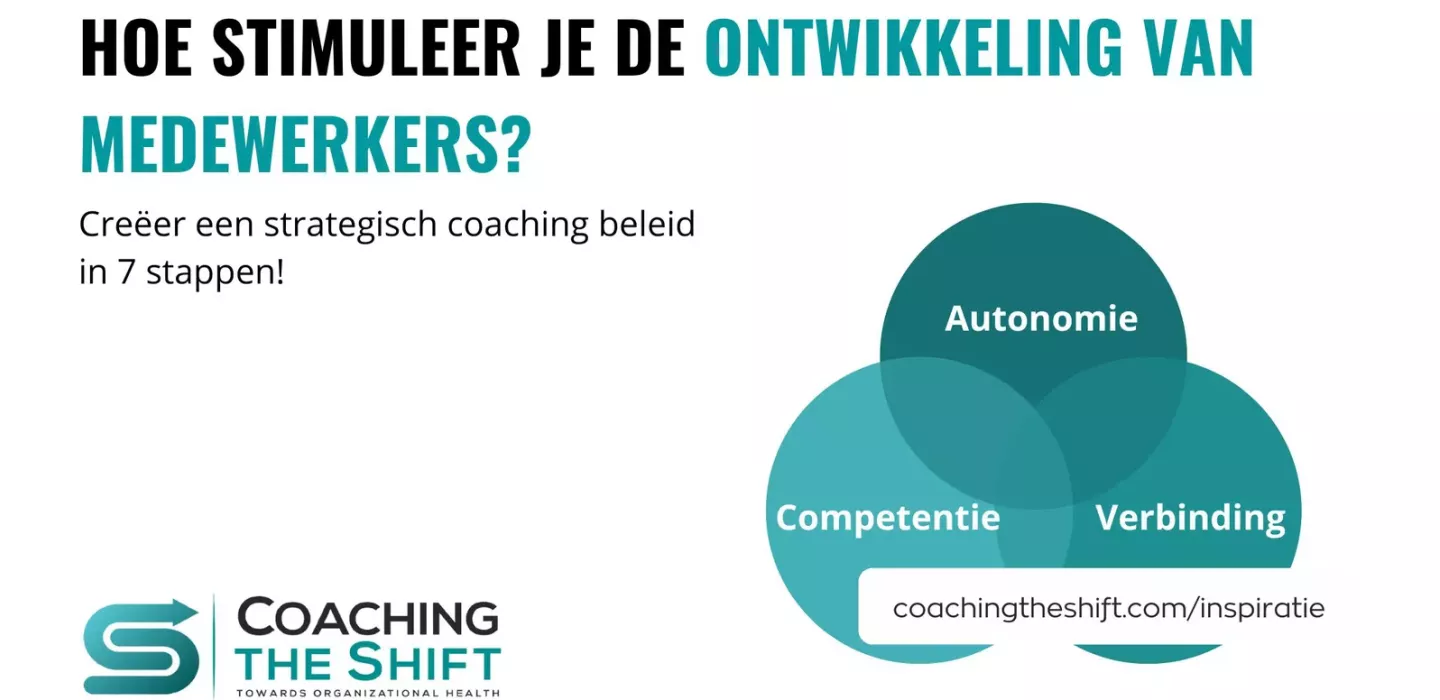
The modern workplace is no longer driven solely by compensation or external motivators. On the contrary, people are looking for opportunities to grow and develop themselves. They want to work from intrinsic motivation. Coaching-oriented organizations support this by addressing three fundamental needs:
- Autonomy – The feeling of control over one’s own behavior, decisions, and goals. Coaching strengthens personal leadership and places responsibility with the coachee.
- Development – The ability to grow within a specific context. Coaching supports employees in purposefully developing competencies and empowering beliefs.
- Connection – The feeling of belonging and being part of something meaningful. Team coaching makes the unspoken discussable and contributes to a healthier work environment where collaboration takes priority.

The importance of a strategic coaching policy
Coaching is still too often seen as a remedy for problems. However, the real power of coaching lies in the long term. Developing a coaching-oriented organizational culture does not happen overnight. It requires time and energy to generate sustainable results — and the longer you invest in it, the greater the return.
At Coaching The Shift, we have experienced this firsthand with several clients. Some organizations have been investing in employee development and coaching for years, and the results are now becoming increasingly visible. Coaching has become embedded in the culture and is supported by role models throughout the organization. But how do you stimulate employee development through a coaching policy?
A strategic coaching policy:
- Stimulates employee development
- Contributes to a more positive workplace culture
- Optimizes team dynamics and collaboration
- Supports change initiatives
- Improves work-life balance
- Increases autonomy and personal leadership
- Strengthens employee retention
- Makes the organization more agile and resilient
By integrating coaching into your strategic HR policy, you create opportunities to inspire and develop multiple generations of employees. The coaching mindset is then actively embodied and practiced at every level of the organization.
How do you stimulate employee development with coaching?
Coaching is a powerful form of guidance that helps people develop themselves on multiple levels. However, a coaching-oriented organization goes beyond individual coaching or competency development. Coaching becomes embedded in business processes as well as in everyday workplace habits and dynamics.
In general, coaching-oriented organizations meet five key criteria:
- Organization-wide support for coaching: Managers, employees, and coaches jointly create a safe environment where people can grow.
- Employees master fundamental coaching skills: Such as giving appreciative feedback, engaging in open dialogue, and setting healthy boundaries.
- Coaching is embedded in processes: Regular check-ins and short feedback cycles are part of daily operations.
- Collective responsibility and engagement: Leaders coach employees, employees coach each other, and executive teams invest in coaching themselves.
- Willingness to change: Employees are encouraged to question outdated systems and experiment with new dynamics.
Ultimately, it is not coaching itself that stimulates employee development, but the increased awareness it creates. For example, when an organization shifts from a fixed mindset to a growth mindset, new possibilities emerge — especially when teams actively leverage each other’s strengths and capabilities.

7 steps toward a successful coaching policy
There is no standard formula for integrating coaching into your organization. On the contrary, the right approach strongly depends on your current context and what is realistically achievable. Still, there are several guiding principles you can follow when designing a successful coaching policy:
- Define strategic objectives – What do you want to achieve through coaching and training? How does this align with the organization’s strategic goals?
- Create support and buy-in – Build commitment from both management and employees.
- Make coaching part of the strategy – Develop a learning plan and allocate a budget to work more purposefully.
- Invest in coaching skills – Encourage employees to develop and apply coaching skills themselves.
- Create a mix of coaches – Combine internal and external coaches to support organizational objectives.
- Embed coaching in processes and culture – Make coaching an integral part of how the organization operates.
- Measure and evaluate – Continuously monitor progress and adjust where needed. How will you celebrate successes? And what will you do if results fall short?
In short, a strategic coaching policy is a valuable investment in the future of both your organization and its people. It not only builds competent teams but also creates motivated and engaged employees.
Curious about what coaching can mean for your organization? Want to stimulate employee development? Book a free intake session today!
Veelgestelde vragen over
de ontwikkeling van medewerkers stimuleren
Other relevant articles