The Lencioni Pyramid
5 team dysfunctions & areas for improvement
Patrick Lencioni is an American organizational consultant and author of the book The Five Dysfunctions of a Team. In this book, he developed his famous team development model: the Lencioni Pyramid. The model defines five characteristics of weak (dysfunctional) and strong (cohesive) teams. In this article, you will learn how to replace a gossip culture with a collaboration-focused team.

Dorothée Willems

Patrick Lencioni is an American organizational consultant and author of the book The Five Dysfunctions of a Team. In this book, he developed his famous team development model: the Lencioni Pyramid. The model defines five characteristics of weak (dysfunctional) and strong (cohesive) teams and is a core component of our team coaching program.
In this article, you will learn how to replace a gossip culture with a collaboration-focused team.
- The Lencioni Pyramid
- The Five Dysfunctions of Teamwork
- Team Development According to Lencioni – Five Characteristics of Strong Teams
- The Lencioni Pyramid Questionnaire
The Lencioni Pyramid
Lencioni’s team development model is not just a pyramid. Just like a pyramid, a team culture is built in layers. Only with the right foundations can you build a strong team. For example, there is little point in emphasizing results when basic needs such as trust are lacking.
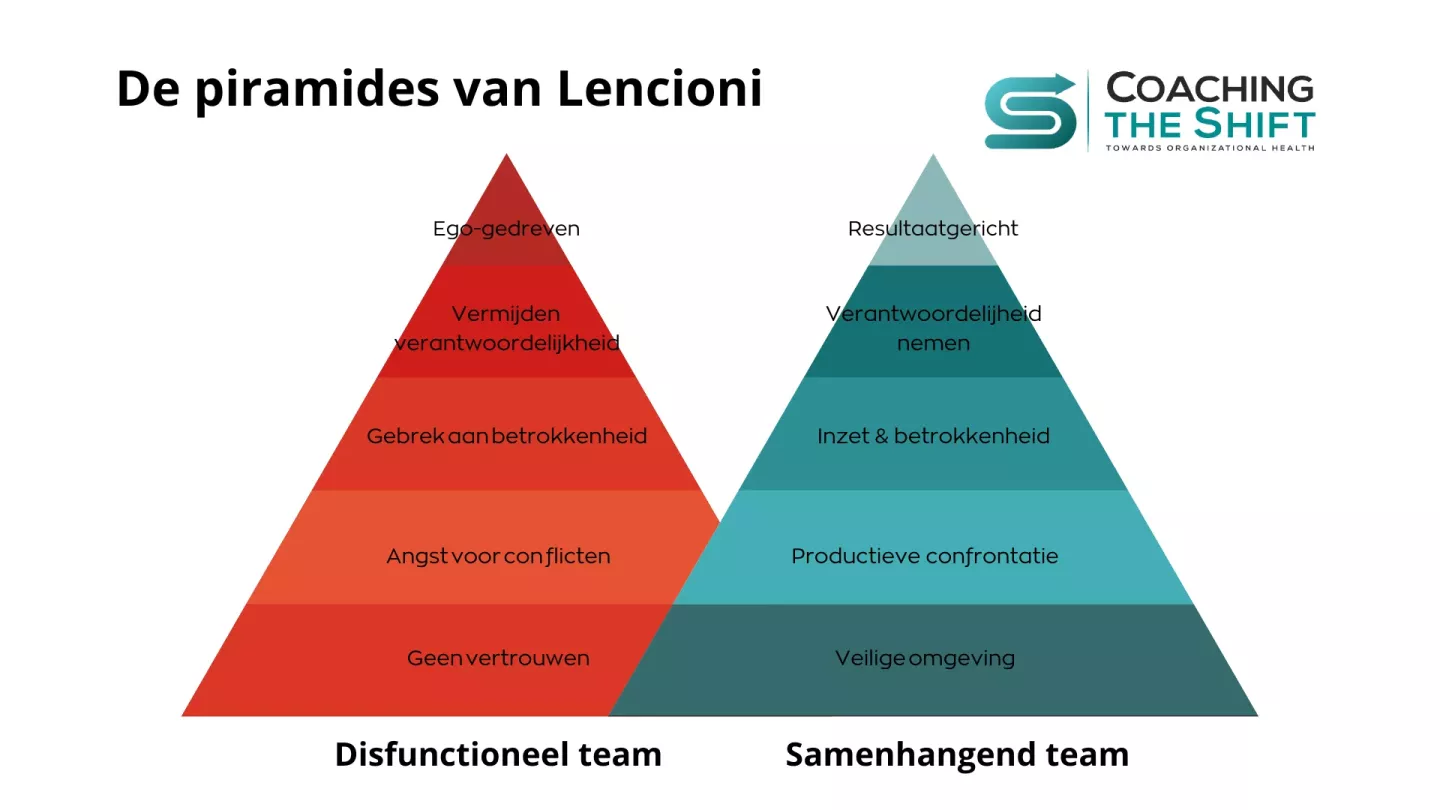
How do you know which side of the pyramid you belong to? At the bottom of this article, you will find a questionnaire based on Lencioni’s team development model.
The Five Dysfunctions of Teamwork

#1 Lack of Trust
Trust is the most important foundation of any strong team. A lack of trust is therefore one of the five dysfunctions of teamwork. Everyone must feel safe enough to admit and discuss mistakes. Only then can a team effectively work on possible shortcomings.
Creating psychological safety and trust is an essential part of our team coaching program. How do you create an environment in which people dare to be open and vulnerable?
#2 Fear of Conflict
When confrontation is avoided, there is no room for constructive feedback and improvement. This fear often stems from a lack of trust. People may be afraid of being personally targeted and lose sight of the team’s common interest.
It is better to express frustrations than to start a gossip culture. Unproductive teams, for example, complain about workload or performance to colleagues, while discussing the issue with the right person could lead to a solution. Addressing issues with mutual respect leads to better results.
#3 Lack of Commitment
This occurs when a team does not feel involved in how the team operates. Not just having a say, but engaging in real dialogue is important. A lack of commitment and involvement often arises when there is little transparency. Teams lack a clear view of the bigger picture and therefore focus mainly on their own silo.
#4 Avoidance of Accountability
The underlying layers of the Lencioni Pyramid create an individualistic mindset within teams. This means team members focus primarily on their own interests and therefore avoid accountability toward the group. Unproductive teams often operate with a “everyone for themselves” mentality.
As a result, they are unlikely to hold others accountable for behavior that does not align with team goals. This quickly leads to a culture of missed deadlines and lateness.
#5 Inattention to Results
When people are driven by ego, they tend to pursue status and recognition. This creates political behavior that leads to resentment within the team. This often comes at the expense of collective goals and collaboration. It is more important to make steady progress toward long-term objectives.
Break the cycle and build a winning team. Discover the power of our team coaching program!
Team Development According to Patrick Lencioni – Five Characteristics of Strong Teams

#1 Create a Safe Environment
A safe environment emerges when there is mutual trust. In such an environment, people dare to be vulnerable without fear of being judged. An environment that allows room for mistakes also creates room for improvement. As a leader, you play an important role model here. By opening up yourself, you invite others to do the same.
#2 Encourage Productive Conflict
In a safe environment, feedback is not taken personally because there is an assumption of positive intent. These confrontations exist to advance the team’s common interest. Feedback is constructive and supports both individual growth and team development.
Although confrontation can be challenging, addressing frustrations openly is always worth the effort.
#3 Increase Engagement & Commitment
Ensure there is a clear understanding of roles and responsibilities within the team. When everyone understands their contribution to the bigger picture, it creates a stronger sense of impact and belonging.
People will only commit when the foundations of the Lencioni Pyramid are in place. Without trust, people will not dare to take risks. In turn, a team cannot feel engaged if there is no room for productive conflict.
#4 Stimulate Team Accountability
When everyone already thinks in terms of team objectives, it becomes easier to foster a sense of accountability. Everyone is aware of each other’s actions and their impact on collective goals. As a result, people take responsibility for their own mistakes—and those of others.
Team members can then call out dysfunctional behavior and help correct it. Once again, it is essential to respect the hierarchy of the Lencioni Pyramid as a team development model. Without commitment, accountability cannot be encouraged.
#5 Establish a Results-Oriented Focus
You can shift attention toward collective results by setting goals together and discussing them openly. Address both the content of tasks and how the team works together. Also make room for appreciation of the team—especially those who contribute to shared objectives. This is only possible once all layers of the team development model are in place.
The Lencioni Pyramid Questionnaire
Where does your team stand in the Lencioni Pyramid? Is your team collaboration-focused, or do dysfunctional behavior patterns keep recurring?
Use the questionnaire below as a self-assessment or as an exercise during a team coaching program or team development journey:
- Is there room for open dialogue and productive conflict within the team?
- Do team members dare to openly admit mistakes and areas for improvement?
- Are team meetings productive, or are decisions repeatedly postponed?
- Does the team quickly align when making decisions?
- Does the team support decisions once they are made, or is there a gossip culture?
- Is the team aware of each other’s work and individual contributions?
- Are decisions made efficiently with the involvement of the whole team?
- Do team members dare to call each other out on non-conforming behavior?
- Does failing to achieve results affect team motivation?
- Are team members willing to challenge and confront one another in pursuit of a shared goal?
Discover more about building high-performing teams in our team coaching program—based on the principles of Patrick Lencioni.

Veelgestelde vragen over de piramide van Lencioni: 5 valkuilen & werkpunten van teams
Inschrijven voor onze nieuwsbrief?
Other relevant articles