What is modeling?
Learning through modeling in the workplace!
What is modeling? Model learning is something we all apply—consciously or unconsciously. Throughout our lives, we pick up all kinds of things from our environment. We identify role models in our upbringing, our circle of friends, and also at work. Sometimes that works to our advantage—but sometimes it doesn’t. Which behaviors, attitudes, or habits are you (un)consciously adopting from your colleagues?
What is modeling?
Model learning is a technique we often apply unconsciously. You (consciously or unconsciously) identify a role model and shape your own behavior and beliefs according to that standard. This can work to your advantage—but also to your disadvantage. Every environment contains both positive and less positive traits that we tend to adopt without realizing it.
Modeling is part of life. We carry many patterns from our upbringing—but also from the workplace. Think about it for a moment: what are you consciously and unconsciously picking up from your colleagues? And how can you use modeling to the benefit of yourself and the team as a whole?
Discover the power of modeling in four phases:
- What is modeling?
- How and why to choose a role model
- Model learning in four phases

What is modeling?
Modeling, or model learning, is the (often unconscious) imitation or adoption of behaviors, beliefs, and values in order to achieve similar results. Much of this happens automatically. We pick up patterns from the people around us and from our upbringing. Parental figures, for example, often serve as role models who help shape what success looks like to us.
We also model behavior in the workplace. Leaders and early team members largely set the behavioral norms and habits within a group. That is why certain habits and traditions in teams can quickly take on a life of their own.
Model learning can also be done consciously. By intentionally choosing a role model in an area where you want to grow, you can significantly shorten your path to success.
How and why to choose a role model
Role models play a key role in modeling. A model provides a clear direction to work toward. You can study which habits make someone successful. Beyond copying behavior, you also adopt underlying beliefs:
- Possibility: Having a successful role model increases your belief that success is possible.
- Ability: By understanding how your role model grew and developed, you strengthen your belief in your own ability to do the same.
- Worthiness: By examining your role model’s beliefs, you learn to develop supportive thoughts that move you toward your goals.
There’s a saying that you are the sum of the five people you spend the most time with. That’s why it’s wise to surround yourself with people you admire. Over time, you will (often unconsciously) start adopting certain habits, beliefs, and ways of thinking—leading to new behaviors and a different mindset.
Model learning in 4 phases
When you want to model consciously, it’s valuable to first look at what is already present in your environment. What can you learn from the people you interact with every day? At the same time, it’s important to stay realistic and preserve your own uniqueness while learning from others
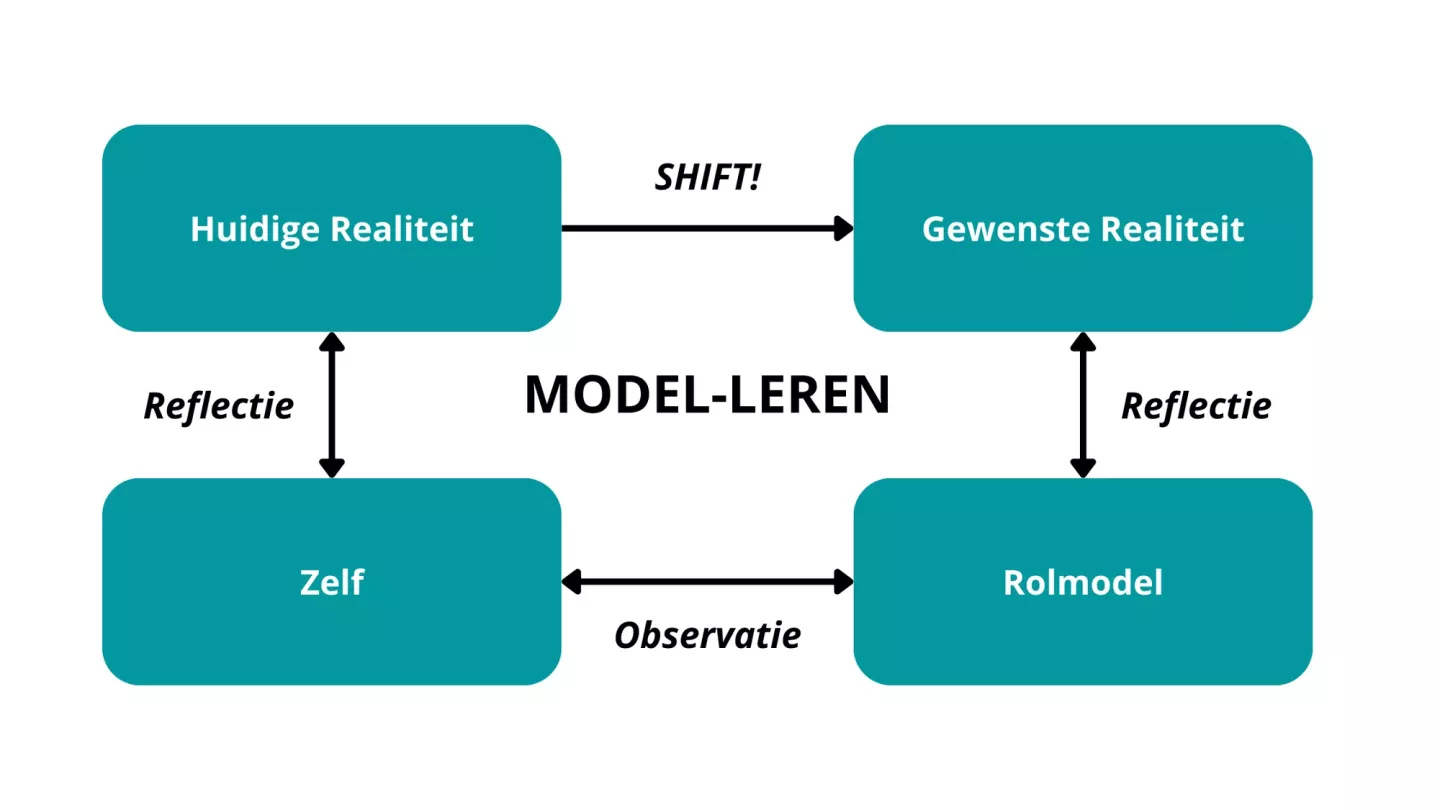
It therefore takes strong skills in observation, reflection, and introspection to actually apply the insights you discover. Here’s how you can learn through modeling in four phases:
1) Find a role model
Identifying or finding a role model is often less difficult than people think. Of course, it’s not about finding one ultimate role model from whom you copy everything. Instead, stay alert to the unique strengths and talents of people in your environment—and make the most of them.
So don’t look too far. To truly choose and accept a role model, you also need to recognize their development. We often hear: “I could never do that. They were just born that way.” But when you actually ask your role model, a different story often emerges.
- Which innate talents and competencies were already present?
- What did you still need to develop to reach this goal?
- How did you do that?
- Who or what helped you in that development?
2) Map out the model
Next, you study your role model to identify what sets them apart from others. You can do this through observation, but also by asking questions. Once you have mapped the model, you can begin to model it.
You can map the model using Bateson’s six logical levels:
- What does your role model’s environment look like? Who do they surround themselves with? With whom do they test ideas or decisions?
- What does your role model do differently?
- What knowledge and competencies does your role model have?
- What does your role model believe that leads them to take these actions? What do they value?
- How does your role model identify themselves? Which aspect of their identity supports this?
- What is your role model’s higher purpose? What do they do it for?

You don’t always get the chance to interview your role models. Still, even from a distance, you can learn a great deal through deep observation. When you pay close attention to the unique strengths and capabilities of others, you can model something from everyone.
We challenge you to take a look at your own team:
Where are your team members strong? And what can you learn from—or adopt—based on that?
3) Reduce it to the essence
Human beings are complex, so it’s not always easy to identify what truly makes someone successful. It helps to focus on the input rather than the results, and to always take context into account.
To illustrate with a simple example: a first year as a leader looks very different from a tenth year as a leader. So don’t base your learning solely on what a leader does today, but rather on what they did to get there. You don’t simply start at the top of the ladder.

In addition, people are much more than what they do. We are human beings, not human doings. What does your role model truly believe in? How do they see themselves? In short, you want to reduce the model to its essence: what are the core elements of this model? Which aspects are you already applying—and which not yet?
4) Make the model your own
A common reaction we hear is: “I’m not like my role model. Will this even work for me?”
Of course, you can’t simply copy someone else’s behavior and thinking and expect exactly the same results. That’s not how it works. You need to stay realistic. Everyone is their own person. To succeed using an existing model, it helps to adapt certain elements and make them your own.
Ask yourself:
- What is realistic and feasible for me to apply?
- Which elements do I want to include in my own model—and which not?
- How can I use model learning to accelerate my learning process?
Like most things, it remains a process of trial and error. You can model elements that have already worked for your role model(s), but there are no guarantees. While modeling may significantly speed up your learning, you still have to walk the path yourself.

In short, modeling is a powerful technique to use in your personal or team development. It helps you become aware of automatic behavior patterns and limiting beliefs, allowing you to consciously choose a different path. Don’t look too far—start applying modeling today!
Veelgestelde vragen over
modelleren en model-leren op de werkvloer
Inschrijven voor onze nieuwsbrief?